Public Book Policies

Public book policies are a set of measures, standards, frameworks and laws that structure and support the book field in a given country : they must strengthen a given country’s book sector, help to support local production, the dissemination and access of all to the book, in particular through the implementation of adequate regulatory and tax measures and the multiplication of reading spaces (public libraries for example). Public book policies need to be developed and implemented with all book professionnals, in each country. It is also necessary for these national policies to be extended by regional and international policies.

Resources

Mapping public book policies in the Arab world, 2025

Available in Arabic, English, French and Spanish.

Following the publication in 2019 of a mapping of public book policies in French-speaking sub-Saharan Africa/ Madagascar and Latin America, the independent publishers of the Arab world are pleased to present the mapping of public book policies in 11 countries in the region : Egypt, Jordan, Kuwait, Lebanon, Morocco, Oman, Palestine, Sudan, Syria, Tunisia and Yemen.

Given the instability and socio-political fragility in the region, this project was a challenge that the project coordination team (Samar Haddad, Atlas Publishing in Syria ; Fayez Allam, Syria ; Hani Altelfah, Marfaa for Culture and Publishing in Turkey) met with determination and conviction.

(Re)experience in pictures the launch of the mapping of public policies in the Arab world, which took place at the Cité de la Culture in Tunis in June 2025.

Objectives and methodology
The mapping was developed between 2018 and 2019 for the following 2 regions : Latin America and Sub-Saharan Africa/ Madagascar. Work to update the data for these two regions has been underway since November 2025. The mapping was finalised in 2025 for the Arab world (the data collected dates from 2023-2024 for this region).

The mapping proposes a comparative approach to public book policies in three regions of the world –Latin America, sub-Saharan Africa/Madagascar and the Arab world– and emphasises the need for them to maintain bibliodiversity in the regions studied. These overviews provide an overall context, particularly through the cross-sectional analyses, as well as information on the specific measures being implemented in each country, through the country profiles. These two levels of information highlight both the similarities and the differences between the countries studied. One of the main aims of this tool is to encourage dialogue between publishing professionals and public authorities to consolidate and/or develop public policies in each country.

For the Arab world, data was collected from book professionals and public authorities in around twenty countries. In many cases, the data collected was not sufficiently accurate or complete : while the absence of and/or difficulty in obtaining information is a significant element of analysis in itself (on the lack of transparency of book support schemes, on the lack of knowledge among book professionals of existing legislative frameworks, on the absence of book-related policies, etc.), the information was too incomplete for these countries to be mapped. There are therefore gaps in this mapping : several countries representing very significant economic and cultural weight for books in the Arab world are not (yet) mapped. This mapping (undoubtedly) contains inaccuracies, even errors : several pieces of information received were contradictory and although they were checked, it was sometimes very difficult to arrive at certainties. We apologise for this in advance and would be grateful for any comments or remarks you may have. The mapping is not set in stone and is work in progress : you can contribute to it (click on “Contribute” when you are in a country file). If you would like to add a country to the map, please contact us : equipe@alliance-editeurs.org

Once the data had been collected, Hani Altelfah (a researcher and publisher based in Turkey) carried out a cross-cutting analysis of the data. This analysis focuses on several key issues, including freedom of expression, the various forms of censorship, the socio-economic environment of the book, intellectual property rights, etc. It is available here in Arabic and here in English.

More information on the methodology and the project here.

Acknowledgements
The International Alliance of Independent Publishers warmly thanks all the book professionals who have contributed to this project ; Samar Haddad, who has tirelessly supported this project, despite all the challenges encountered and the many moments of doubt ! Fayez Allam, who worked behind the scenes with immense patience ; Hani Altelfah for his energy and the quality of his analyses ; Franck Mermier for his proofreading and advice ; the team of translators and proofreaders (Dahouk Rukieh, Abdulla Fadel, Anna Akkash) ; Dépli Studio for designing the mapping website ; Nouri Abid (Med Ali, Tunisia) for organising the mapping launch in Tunis.

Finally, the Alliance would like to thank the Open Society Foundations for their invaluable support and trust.

JPEG - 451.4 kio

Partager l'article

Mapping public book policies in the Arab world - in Arabic, 2025

Following on from those carried out for Latin America and French-speaking sub-Saharan Africa, the Alliance’s Arabic-language network finalised the mapping of public policies in the Arab world, which was launched in Tunis in June 2025.

Speakers :

* Hani Altelfah (author of the study on public book policies in the Arab world and publisher, Al Marfaa, Turkey)
* Samar Haddad (Atlas Publishing, Syria)

Moderated by Dina Kabil (El Maraya, Egypt)

Partager l'article

What public policies for books in French- and English-speaking Africa, 2025

In 2019, the Alliance drew up a map of public policies for books in French-speaking sub-Saharan Africa, highlighting the mechanisms and policies for supporting books in 12 countries, as well as pointing out the absence or shortcomings of certain government initiatives to promote publishing and bibliodiversity. With a view to extending this mapping to English-speaking African countries, and to encourage dialogue and the exchange of experience and practices between players in the ’African’ book industry, this round table will give the floor to publishers from 3 English-speaking African countries (Ghana, Kenya and Nigeria) and publishers from 2 French-speaking African countries (Cameroon and Togo). Book professionals from other countries who will be attending these discussions will be invited to share their points of view, so we look forward to seeing many of you there !

Speakers :
* Ama Dadson (Akoo Books, Ghana)
* Serge D. Kouam (Presses Universitaires d’Afrique, Cameroon)
* Muthoni Garland (Storymoja Publishers, Kenya)
* Ibiso Graham-Douglas (Paperworth Books, Nigeria)

Moderated by Yasmîn Issaka-Coubageat (Graines de Pensées, Togo)

Partager l'article

Introduction to the German-language independent publishing, 2024

There are hundreds if not thousands of independent publishing houses in the German-speaking countries (Germany, Austria and Switzerland). While operating in such a strong book market can certainly have benefits, a lot of those publishers are struggeling – not only with the competition in the market and the omnipresent difficulties in the world, but also with the changing role of books in our society and the change in the behavior of readers. How do these publishing houses survive, what are their challenges and strategies and what role do publishing collectives like SWIPS (Switzerland) and KURT WOLFF STIFUNG (Germany) play in helping these publishers ?

Speakers :
* Annette Beger (SWIPS - Swiss Independent Publishers / Kommode verlag, Switzerland)
* Daniel Beskos (Kurt Wolff Stiftung / mairisch Verlag, Germany)
* Tanja Raich (Leykam Verlag, Austria)

Partager l'article

Brief Manual of Best Practices for Public Book Procurement, 2024

“It is important to understand the key role that the public procurement of books plays–similar to that of roads in a country’s development–and the related impacts of these actions on the ecosystem of books, culture, and education.

In purchasing books and socializing the processes of reading, the state’s actions may have numerous impacts. The selection of books is not only a question of quality and price, nor is it a simple technical process or an isolated action.”

This document is based on the Brevísimo manual de buenas prácticas para las compras públicas de libros (print and digital) that was included in the work of the Comisión de Compras Públicas de la Política Nacional de la Lectura y el Libro 2015-2020 (Chile), prepared by Paulo Slachevsky, coordinator of the commission. We are grateful to Germán Gacio Baquiola for his critical feedback and contributions.

Read the Manual

Partager l'article

Translation and publishing in Arabic : spotlight on the challenges ahead, 2023

The question of translation is a real issue in the publishing ecosystem of the Arab world : indeed, the absence of translators of some languages obliges translators to translate into an intermediary language ; given the high costs this represents, it is sometimes difficult to be sure a translation conforms to the original text. Sometimes the publishing projects of an author or series of books do not correspond with the visions and interests of translators, which leads to lack of understanding, or even obstacles for the translation of some texts. There are numerous challenges, but possible actions will also be put forward at this round table discussion, in particular the creation of training institutions.

Babelica is the International online Book Fair of Independent Publishing, conceived and organised by the network of publishers of the International Alliance of Independent Publishers. All the information about the 2023 edition can be found at babelica.alliance-publishers.org

Partager l'article

Manual de buenas prácticas para las compras públicas de libros, 2024

“Una buena política de adquisición de libros por parte del Estado tiene múltiples y significativos impactos en el desarrollo cultural, social, económico y político de un país […] Por todo ello es tan importante mejorar, incrementar, trasparentar, desconcentrar y fortalecer la presencia de autoras/es y editoriales locales en los procesos de compras públicas de libros. También analizar, revisar y diversificar constantemente las áreas en que se centran los gastos, como los libros de textos que concentran generalmente gran parte del gasto público en libros.”

Este documento reproduce, con algunas modificaciones, el Brevísimo Manual de buenas prácticas para las compras públicas de libros (en papel y en formato digital) que fue incorporado al trabajo de la Comisión de Compras Públicas - Política Nacional de la Lectura y el Libro 2015-2020 (Chile), realizado por Paulo Slachevsky (LOM Ediciones, Chile) como coordinador de la Comisión. Este manual ha sido revisado por Germán Gacio Baquiola (Editores independientes de Ecuador).

Leer el manual

Partager l'article

Giving new value to intellectual work, 2023

Piracy, neoliberal pressure and the absence of public reading policies are among the factors that have a negative impact on books and intellectual work. This workshop aims not only to set out the issues leading to the « casualisation » of intellectual work, but also to present possible solutions.

Babelica is the International online Book Fair of Independent Publishing, conceived and organised by the network of publishers of the International Alliance of Independent Publishers. All the information about the 2023 edition can be found at babelica.alliance-publishers.org.

Partager l'article

VAT Changes for Books in Brazil, 2020

Read here the IPA (International Publishers Association) support, and here the manifesto published by the Brazilian actors, to defend the book in Brazil.

Partager l'article

Mapping public book policies

Mapping public book policies in the Arab world, 2025

Available in Arabic, English, French and Spanish.

Following the publication in 2019 of a mapping of public book policies in French-speaking sub-Saharan Africa/ Madagascar and Latin America, the independent publishers of the Arab world are pleased to present the mapping of public book policies in 11 countries in the region : Egypt, Jordan, Kuwait, Lebanon, Morocco, Oman, Palestine, Sudan, Syria, Tunisia and Yemen.

Given the instability and socio-political fragility in the region, this project was a challenge that the project coordination team (Samar Haddad, Atlas Publishing in Syria ; Fayez Allam, Syria ; Hani Altelfah, Marfaa for Culture and Publishing in Turkey) met with determination and conviction.

(Re)experience in pictures the launch of the mapping of public policies in the Arab world, which took place at the Cité de la Culture in Tunis in June 2025.

Objectives and methodology
The mapping was developed between 2018 and 2019 for the following 2 regions : Latin America and Sub-Saharan Africa/ Madagascar. Work to update the data for these two regions has been underway since November 2025. The mapping was finalised in 2025 for the Arab world (the data collected dates from 2023-2024 for this region).

The mapping proposes a comparative approach to public book policies in three regions of the world –Latin America, sub-Saharan Africa/Madagascar and the Arab world– and emphasises the need for them to maintain bibliodiversity in the regions studied. These overviews provide an overall context, particularly through the cross-sectional analyses, as well as information on the specific measures being implemented in each country, through the country profiles. These two levels of information highlight both the similarities and the differences between the countries studied. One of the main aims of this tool is to encourage dialogue between publishing professionals and public authorities to consolidate and/or develop public policies in each country.

For the Arab world, data was collected from book professionals and public authorities in around twenty countries. In many cases, the data collected was not sufficiently accurate or complete : while the absence of and/or difficulty in obtaining information is a significant element of analysis in itself (on the lack of transparency of book support schemes, on the lack of knowledge among book professionals of existing legislative frameworks, on the absence of book-related policies, etc.), the information was too incomplete for these countries to be mapped. There are therefore gaps in this mapping : several countries representing very significant economic and cultural weight for books in the Arab world are not (yet) mapped. This mapping (undoubtedly) contains inaccuracies, even errors : several pieces of information received were contradictory and although they were checked, it was sometimes very difficult to arrive at certainties. We apologise for this in advance and would be grateful for any comments or remarks you may have. The mapping is not set in stone and is work in progress : you can contribute to it (click on “Contribute” when you are in a country file). If you would like to add a country to the map, please contact us : equipe@alliance-editeurs.org

Once the data had been collected, Hani Altelfah (a researcher and publisher based in Turkey) carried out a cross-cutting analysis of the data. This analysis focuses on several key issues, including freedom of expression, the various forms of censorship, the socio-economic environment of the book, intellectual property rights, etc. It is available here in Arabic and here in English.

More information on the methodology and the project here.

Acknowledgements
The International Alliance of Independent Publishers warmly thanks all the book professionals who have contributed to this project ; Samar Haddad, who has tirelessly supported this project, despite all the challenges encountered and the many moments of doubt ! Fayez Allam, who worked behind the scenes with immense patience ; Hani Altelfah for his energy and the quality of his analyses ; Franck Mermier for his proofreading and advice ; the team of translators and proofreaders (Dahouk Rukieh, Abdulla Fadel, Anna Akkash) ; Dépli Studio for designing the mapping website ; Nouri Abid (Med Ali, Tunisia) for organising the mapping launch in Tunis.

Finally, the Alliance would like to thank the Open Society Foundations for their invaluable support and trust.

JPEG - 451.4 kio

Partager l'article

Mapping public book policies in Latin America and Sub-Saharan Africa and Madagascar

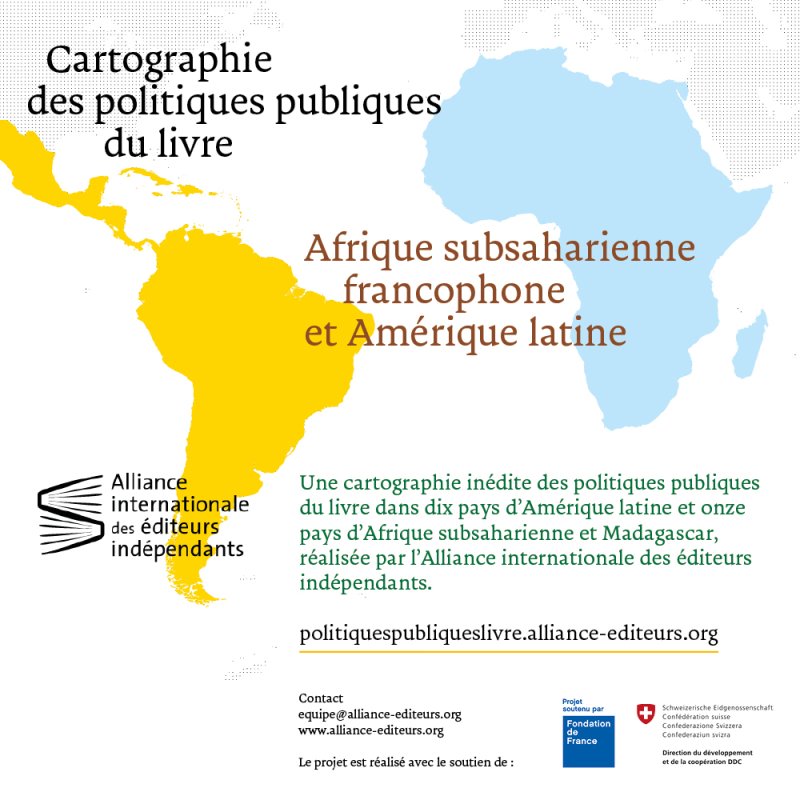
An unprecedented mapping of policies supporting reading and books in 22 countries, which can be consulted and downloaded online : publicbookpolicies.alliance-editeurs.org

Arising from the observation of the lack of data on public book policies in regions where the member publishers of the Alliance operate, particularly in Latin America and sub-Saharan Africa, the public book policy mapping project is the result of several years of collaboration between book and publishing professionals, academics and experts on public book policies. It relies first and foremost on the investment and involvement of the Alliance’s member publishers, who are its primary actors. It is one of the flagship projects of the Bibliodiversity Observatory.

The mapping proposes several items : one entry per country (country fact sheets listing existing mechanisms for public support for books at the national level) ; a regional entry (comparative data through cross-cutting analyses). It is interactive and evolving : the fact sheets presenting the institutions and national public book policies can be amended and modified as the systems evolve. This mapping is thus intended to be extended to new countries in both regions, or even to integrate a new region in the long term (the Arab world in particular). For now, the mapping exists only in Spanish and French for lack of financial means to carry out a translation into English. The Alliance hopes to find the necessary funds to translate the mapping into English soon.

The objectives of the mapping are to :
• make available data on the public book policies of the respective countries ;
• offer an overview of public book policies, freely accessible, consultable and reusable by professionals and public authorities ;
• promote dialogue and exchanges between public authorities and publishers ;
• develop advocacy tools for independent publishers ;
• contribute to the establishment and consolidation of public book policies in developing countries (among others, for a greater circulation of books and ideas, for the appropriation of digital tools by book professionals, for balanced exchanges between North and South) ;
• affirm the role of civil society (book professionals and particularly independent publishers) in the development and implementation of public book policies.

JPEG - 457.1 kio

The Alliance warmly thanks the partners of this project : the Fondation de France and the Swiss SDC.

See the complementary issue of the Bibliodiversity journal “Public book policies”.

Press release

If you have any questions, please do not hesitate to contact the Alliance team at : equipe@alliance-editeurs.org

Partager l'article

Recommander cette page