In October 2024, the members of the Alliance decided to create a space of solidarity with book professionals in Palestine, to promote and encourage the circulation of Palestinian texts across continents, and to make the voice of book professionals in Palestine heard.
This space is flexible and will take different formats. In 2026, the Alliance is offering a catalogue of titles on Palestine (titles published by Palestinian publishing houses and/or about Palestine). This catalogue is based on titles proposed and recommended by Alliance members. The primary objective of this catalogue is to promote projects involving the transfer of rights, co-publications and translations of titles published in Palestine or about Palestine. It will be regularly updated and expanded.
In June 2025, Arabic-speaking publishers (including Palestinian publishers) and French-speaking publishers gathered in Tunis for meetings organised by the Alliance to present titles from their catalogue on Palestine, with a view to exchanging rights (transfer of rights, co-publications, translations).
For several months now, the International Alliance of Independent Publishers has been working alongside Double Ponctuation to publish a very special issue of the journal Bibliodiversité, which gives a voice to 30 young authors under the age of 30, from 30 different countries. Invited through the Alliance’s member publishers, these young authors speak out and tell us about their world, their society, their anxieties, but also their struggles, their utopian visions and their hopes.
This huge project will not only result in a collection of texts entitled “Resist and Hope” but will also shape our discussions within Babelica.
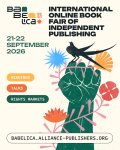
They live in Niger, Morocco, the Philippines, Singapore, India, Afghanistan, Palestine, Mozambique, Uruguay, Chile, Ukraine, the Czech Republic, Turkey… ; these young talents will take centre stage at the 2026 edition of Babelica, and we invite you to listen to them and engage in dialogue with them on 21 and 22 September !
“Now that we have entered the 21st century, it is difficult to dissociate the end from the means : what to say, and where to say it ? Thus, we find that many authors seeking to promote debate, creativity and critical thinking, justice and equality are published by large conglomerates with multiple editorial labels. Isn’t the transformative power of these works reduced to nothing when they plunge into the workings of the entertainment industry ? It is a fact that transnational corporations, whatever their field of action, are the very expression of the system that dominates us. By choosing them as publishers, do we not somehow leave the world of transformative ideas in the hands of those who lay the foundations of the model we criticise ? Doesn’t that strengthen the control of big capital over the word and our daily lives ? Moreover, how can we not question the cross-industry investment of the business groups that own publishing houses ? And, are these investments neutral ?”
In this open letter, independent publishers invite all the actors of the book industry to reflect with them on their practices and the impacts that result from them. In particular, they call on authors, academics and intellectuals to work on projects whose vocation is to transform the order of things and not to consolidate the status quo, to publish their works in independent publishing houses in their own countries, and to give preference to independent publishing houses when it comes to transferring foreign and translation rights.
As the world suffers the health, social and economic consequences of the pandemic, book ecosystems and independent publishing houses are further weakened and, for some, are trying to survive. If solidarity between creators and book professionals is one of the foundations of bibliodiversity, this solidarity is vital in the current context.
In a period when freedoms such as the right to write, to publish, and to read are increasingly under threat, we revisit the insights and perspectives shared by independent publishers during the Babelica Book Fair.
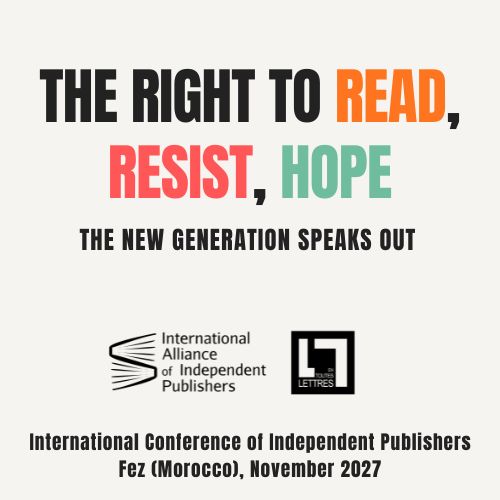
The right to read, resist, hope The new generation speaks out
Initiated by the International Alliance of Independent Publishers, the Fez Conference is organised in collaboration with En toutes lettres in Morocco, which put forward Fez’s candidacy to host this upcoming major event.
Common thread Strengthening and promoting the values of the Alliance
In 2021, while the world was living to the rhythm of the Covid pandemic, preparations were underway for the 2021 Pamplona Conference, with one key word in mind : REthink. How would independent publishing be built “after” ? What would be the responsibility of independent publishers in the transitions and transformations of tomorrow ? How can we (re)affirm the role of bibliodiversity in building more emancipated, freer and fairer societies ? The Declaration that came out of the Pamplona Conference reflected (and still reflects) the collective will of independent publishers to work “For a decolonial, ecological, feminist, free, social and united independent publishing”, recalling their commitment to the cultural, social and political nature of books and reading ; the democratisation of books in society ; reading as an emancipatory practice that forges the critical spirit of citizens, as active participants within their society.
Following the 2021 Conference, several initiatives were set up : a Guide to Good Practice, thematic working groups within the Bibliodiversity Observatory, the Babelica Book Fair dedicated to independent publishing on an international scale, translation and co-publishing projects, mapping, analyses, workshops, meetings, etc.. At the same time, the Alliance network has grown and welcomed new publishing houses (particularly in Asia and the Arab world). A lot has happened in 6 years.
The Conference will therefore continue the work and reflection that are at the heart of the Alliance network around these issues (book ecology, public book policies, freedom to publish, solidarity co-editions, digitalisation/ AI, etc.) and commitments made by independent publishers.
• Passion at the expense of health (mental, financial, physical...) ?
• Which book for which reader ?
• Status of book donations ?
• What are the alternatives to industrial piracy ?
• What are the uses and practices of AI for independent publishing ? What are the possible “ethical” alternatives ?
• What are the good ecological practices for publishers ?
• What translations from so-called ‘minority’ languages into the dominant languages ?
Inclusive and welcoming ; fostering dialogue and amplifying voices
The 2027 Conference is also shaped by several key words : ‘everyday’ youth/ Gen Z/ LGBTQIA+ voices/ censorship (and the circumvention of censorship)/ mental health/ well-being/ safe spaces/ inclusion/ critical thinking...
A chaotic and bruised world
Since 2021, new conflicts have erupted around the world, and the violence of war has become a daily reality for more publishers. The rise of nationalism, conservatism and authoritarianism has spread throughout societies, with waves of racism and sexism threatening diversity (gender, religious, cultural, etc.). Natural disasters have multiplied, rendering us powerless spectators of a predicted climate crisis. Financial and technological empires have been formed and consolidated, imposing a standardisation of content, undermining the current book ecosystem and limiting freedom of expression and critical thinking.
It is in this increasingly chaotic and bruised world that we find ourselves 6 years on... A world where it is becoming difficult to listen to one another, to engage in dialogue, to disagree. A world where the debate of ideas and books is threatened (even banned), where censorship (and self-censorship) prevents a plurality of points of view and testimonies...
Spaces of solidarity and resistance
In this context of retreat, difficulties and even dangers for the expression and representation of all diversities, there are many spaces of solidarity and resistance on a small or large scale that achieve great things. These “safe spaces” can be helpful, unifying and hopeful. These spaces of solidarity and resistance will be at the heart of the forthcoming International Conference of Independent Publishers.
• How can we resist together ?
• What are the means of circumventing the attacks on freedoms ?
• What social and political role do books and publishers play ?
• How do we discuss complex and sensitive issues in an intercultural context ?
• How do we publish in times of crisis and war ?
• How do we take care of ourselves, of these spaces of solidarity ?
Other voices/ directions
In Indonesia, Madagascar, Morocco, Nepal, Peru... the Generation Z is on the streets, demanding new possibilities, calling for greater social justice and dreaming of a dignified life. This new generation will lead the Conference, thanks to a partnership with the School of Critical Thinking, an initiative run by En toutes lettres in conjunction with the Faculty of Legal, Economic and Social Sciences at Sidi Mohamed Ben Abdellah University, Fez. A group of students and emerging book professionals will develop the Conference programme, facilitate the debates and discussions and share their experiences and perspectives.
• How and around what issues is the new generation organising its resistance ?
• What role and place do books and reading play in this resistance - and more broadly for the new generation ?
• What are the ways in which Gen Z organise themselves and their knowledge ?
• What are the hopes and utopias of young people ?
• How can we build bridges (between cultures, generations, etc.) ?
As a unique moment for the independent publishing movement, the Conference highlights another facet of the world of books, made up of a multitude of voices that are often marginalised and stifled. Based on intercultural dialogue, solidarity and a plurality of approaches, the Conference is a forum for discussion, reflection, research and action. It provides an overview of independent publishing worldwide (Latin America, Africa, Asia, Europe, the Arab world and Oceania) : it sets the tone for the trends and issues that are shaping the world of books - and, more broadly, the state of the world.
More information here (document under development, currently being collectively constructed !) :
Auteur(s) : Mouneer AL-SHAARANI
Pays de parution : Égypte, Émirats arabes unis, Liban, Syrie, Tunisie
Langue(s) :
anglais
, arabe
, espagnol
, français
Écrit en arabe avec une traduction en français, anglais et espagnol, ce livre est coédité par 5 membres du réseau arabophone de l’Alliance internationale de l’édition indépendante (Atlas Publishing, Damas ; Arab Diffusion, Beyrouth ; El Ain, Le Caire ; Med Ali, Sfax et Mamdouh Adwan, Sharjah).
After earning a bachelor’s degree from Sciences Po Rennes and spending a year abroad in Chile, Eulalie Patat is currently pursuing a Master’s degree in Cultures and Transitions at Sciences Po Rennes. Interested in issues of cultural diversity, the circulation of knowledge, and book policy, she is focusing on the independent and socially conscious publishing sector. In 2025, she joined the team at the International Alliance of Independent Publishers.
More than 160 independent publishing houses from 58 countries took part in Babelica : for those wondering what bibliodiversity is, here is a fine example of it through the diversity of titles, languages, countries, points of view and sensibilities represented by these publishing houses. A multitude of voices, often invisible, can be discovered here.
Some excerpts from the round tables at this edition of Babelica : #Palestine
“Even though the books were destroyed and burnt, making them unsuitable for reading, we found another use for them. We distributed them to the inhabitants so that they could use them as fuel, so that they could cook in the absence of gas. In this way, the books became a means of subsistence” Samir Mansour (Samir Mansour Bookshop & Printing, Gaza)
“It is crucial to document the situation of the authors : who has been killed, what are their publications ? We must honour the authors in Gaza and archive their work, both on paper and digitally” Fuad Akleek (Al Raqamia Publishing House, Jerusalem)
“As soon as the war ends, we will work together, hand in hand, to restore culture to its rightful place in the Gaza Strip. We will resume our role with even greater vigour, to produce new books and reconstitute what has been lost in private, public and collective libraries. In this way, we will pass on the torch to the new generation, so that they carry it armed with culture and conscience, and not in ignorance of their history” Atef Al Durra (Al Kalima Publishing House, Gaza)
#Freedom to publish
“When the statehood is in danger, and when we see the aggressor is investing so much money in propaganda and in the destruction of our culture, our language, everything, we are forced to impulse censorship because that’s the way to survive and to protect what is ours. In peaceful time, the question of censorship will be a totally different point of discussion but right now, unfortunately, that’s the need” Slava Svitova (Creative Women Publishing, Ukraine)
“When we chose to not publish in Urdu and to publish in English, that’s the big self-censorship that we have” Saeed Husain (Folio Books, Pakistan)
“Writers who are critical of the government, of policies, writers who express their identity are facing censorship, imprisonment, judicial, arrests. Governments use security laws to shoot down critical voices. The main tendencies are digital shot down ; LGBTQIA+ writers are attacked, books are banned – in America last year, we had 10 000 instances of books banned” Romana Cacchioli (PEN International)
#Public Book Policies
« We cannot escape the legacy of colonial policy. Publishing is developed around text books, importations, and not really around an independent creative publishing. Today, our industry really reflects the influence of this colonial culture. English is the dominant language in schools for reading for young people in Ghana and in many parts of Anglophone Africa. That is a lot of work for independent publishers to produce works in the creative space and in local languages but they struggle » Ama Dadson (Akoo Books, Ghana)
« This study explores the publishing policies in the Arab world, involving publishing specialists from eleven Arab countries. It focuses on several key themes, including : freedom of expression, the publishing industry, book-related public policies, various forms of censorship, the book-related socioeconomic environment, intellectual property rights and other relevant issues » Hani Altelfah (Al Marfaa, Turkey)
Speakers :
Tobiloba Afolayan, Nigeria
Sufian Massalema, Czech Republic
Azadeh Parsapour, Iran/UK (Nogaam) Moderated by Hani Altafah, Syria/Turkey (Marfaa for Culture and Publishing)
Tobiloba Afolayan : “Exile has affected my identity positively. I love myself more, and I’m living what I love. I’m living the kind of life I want.”
Sufian Massalema : “I am one of the organizers of a festival of Arabic culture in the Czech Republic because I realized I am living in a privileged country. It is not hard for me to publish books or be active culturally [...] but it’s harder for people who are living in countries like Egypt or Syria. [...] It makes sense for me to use my privilege to help authors publish their books from those less privileged countries or countries that are under some sort of repressive regime.”
Azadeh Parsapour : “As exile publishers, we can be useful and essential in preserving the culture, the heritage, the language, and the narratives because [...] we need to do advocacy publishing.”
Zainab Akhlaqi : “Writing is actually connecting me to my roots, I think of it as a bridge that connects me to my roots and to my country.”
This panel discussion took place during the 2026 edition of the Babelica Book Fair.
Speakers :
Angeli Lacson, Philippines
Max Pasakorn, Singapore
Rocío Medina, Uruguay
Beatriz Llenín Figueroa, Puerto Rico (Editora Educación Emergente) Moderated by Manuel Retamal, Chile (Invertido Ediciones)
Angeli Lacson : “There is so much power in us being able to get together and I see spaces like these, connecting people across countries, across languages, across cultures. This is a very important pathway to building this international solidarity.”
Max Pasakorn : “Giving up is actually so freeing because it means that you don’t have to fit in line, and when people look at you weirdly it doesn’t mean that you’re wrong, it means that you are just being you and the rest of space is wrong or rather there is friction between the people around you and who you are. For me, like in order to exist as a queer person in this conservative space, the only way is to resist it.”
Rocío Medina : “I always reflect on the fact that if I was a man, probably my work would be much easier.”
Beatriz Llenín Figueroa : “That’s what our project is about : to go against the dominant market of what they establish, against the standard”.
This panel discussion took place during the 2026 edition of the Babelica Book Fair.
Intervenant·es :
Salifou Djibo, Niger
Léanne Ramassamy, Martinique
Yoan Francis, Maurice
Ghislain Kabuyaya, République démocratique du Congo (Fleuve de l’Intrigue)
Déborah Pépé, Haïti Modération par Laëtitia Saint-Loubert (France)
Salifou Djibo : « Ce serait un monde dans lequel aucune littérature n’aurait besoin d’être validée dans un centre extérieur pour être considérée comme légitime. Ce serait un monde dans lequel tous les écrivains africains, caribéens, océaniens, seraient lus pour ce qu’ils écrivent et non pas pour l’image exotique que l’on a d’eux. Décoloniser le livre serait de rétablir une égalité de dignité entre les récits. »
Léanne Ramassamy : « On entend beaucoup parler de la résilience haïtienne, c’est un vrai sujet dans la littérature et l’imaginaire antillais. Mais la résilience a ses limites, les humains ont leurs limites et cette demande de toujours résister encore et encore indéfiniment c’est encore une fois nier la problématique. »
Yoan Francis : « Les auteurs mauriciens, pour se faire reconnaître, doivent publier et éditer leurs textes ailleurs pour qu’ensuite ils aient plus de valeur et de reconnaissance, pour exister et se faire de la place dans ce monde assez compétitif qu’est la littérature. »
Ghislain Kabuyaya : « On se rend de plus en plus compte que les gens ne sont pas vraiment au courant de leur propre réalité, de leur propre histoire. Il y a trop peu de jeunes congolais qui maîtrisent l’histoire de la RDC, alors que beaucoup maîtrisent l’histoire de l’Europe par exemple. […] Tout ça est beaucoup plus lié à l’imaginaire, le mental a été colonisé durant très longtemps. »
Déborah Pépé : « Je pense qu’il faut décoloniser notre rapport à ces thèmes [violence, dénuement, misère] et qu’en tant qu’écrivain·e haitien·ne il nous faut avoir une vision plus large, il faut parler de ces thèmes mais avec une certaine précaution de manière à ne pas réduire la réalité. Il nous incombe de fournir une image plus diversifiée et complexe de cette réalité afin de ne pas alimenter certains narratifs qui veulent réduire la réalité haïtienne à seulement la violence et le dénuement. »
Cette table ronde s’est déroulée dans le cadre de l’édition 2026 du salon du livre Babelica.
Ponentes :
Melisa Nungaray Blanco, Mexico
Ian Uviedo, Brazil
Nataschia Navarro, Chile
Rubén Yucra, Peru Moderación : Mar Carrera, Spain (Pol·len Edicions)
Melisa Nungaray Blanco : “Me parece interesante no ver la naturaleza como un objeto de estudio, como algo exterior a nosotros pero integrarla poco a poco a la sociedad.”
Ian Uviedo : “La naturaleza es como siempre la respuesta.”
Nataschia Navarro : “No existe la posibilidad que no haya esa conexión.”
Rubén Yucra : “Nuestra cultura piensa, nuestra cultura questiona, crea conocimientos, y propone formas de entender el mundo de manera mas profundo.”
Speakers :
Slava Svitova, Ukraine (Creative Women Publishing)
Bayan Rashad Faraj, Palestine
Qamar Abdulrahman, Palestine
Anastasiia Lytvynenko, Ukraine
Hala Bizri, Lebanon (Snoubar Bayrout) Moderated by Samar Haddad, Syria (Atlas)
Slava Svitova : “When we talk about these small, manageable communities, this is what authoritarian systems are afraid of : these little communities that you can’t destroy. You can destroy physical buildings, or you can destroy an institution, but you can’t destroy these resilient circles of people who are crisscrossing and are ready to build horizontal networks.”
Bayan Rashad Faraj : “The most dangerous thing that people can use is their ability to dream.”
Qamar Abdulrahman : “The most important form of resistance in our life during war is to live our daily life as human beings, to live our teenage lives.”
Anastasiia Lytvynenko : “For Ukrainians, it’s very unusual not to feel guilty when you’re creating those safe spaces. You usually think, ‘Oh my God, there is a war out there and I am here, chilling with my coffee, writing part of my novel and enjoying this life.’ We constantly feel guilty, and writing, expressing myself, and doing some art probably are some of the least guilty pleasures of my life here, living in the war.”
Hala Bizri : “Many communities give you a sense of oxygen, and we move from one place to another to see where we can belong. When you help others, you feel like you’re helping yourself.”
Samar Haddad : “You shouldn’t feel guilty if you smile, if you laugh, if you listen to music, if you go to a concert, if you go to an art exhibition. You shouldn’t feel guilty if the times are bad. For example, in Damascus, there was a concert and people attended in large numbers. Some of them were crying, but it was a sense of collectiveness, a sense of solidarity.”
This panel discussion took place during the 2026 edition of the Babelica Book Fair.
Speakers :
Amir Muhammad, Malaysia (Buku Fixi)
Lorna Zita, Mozambique
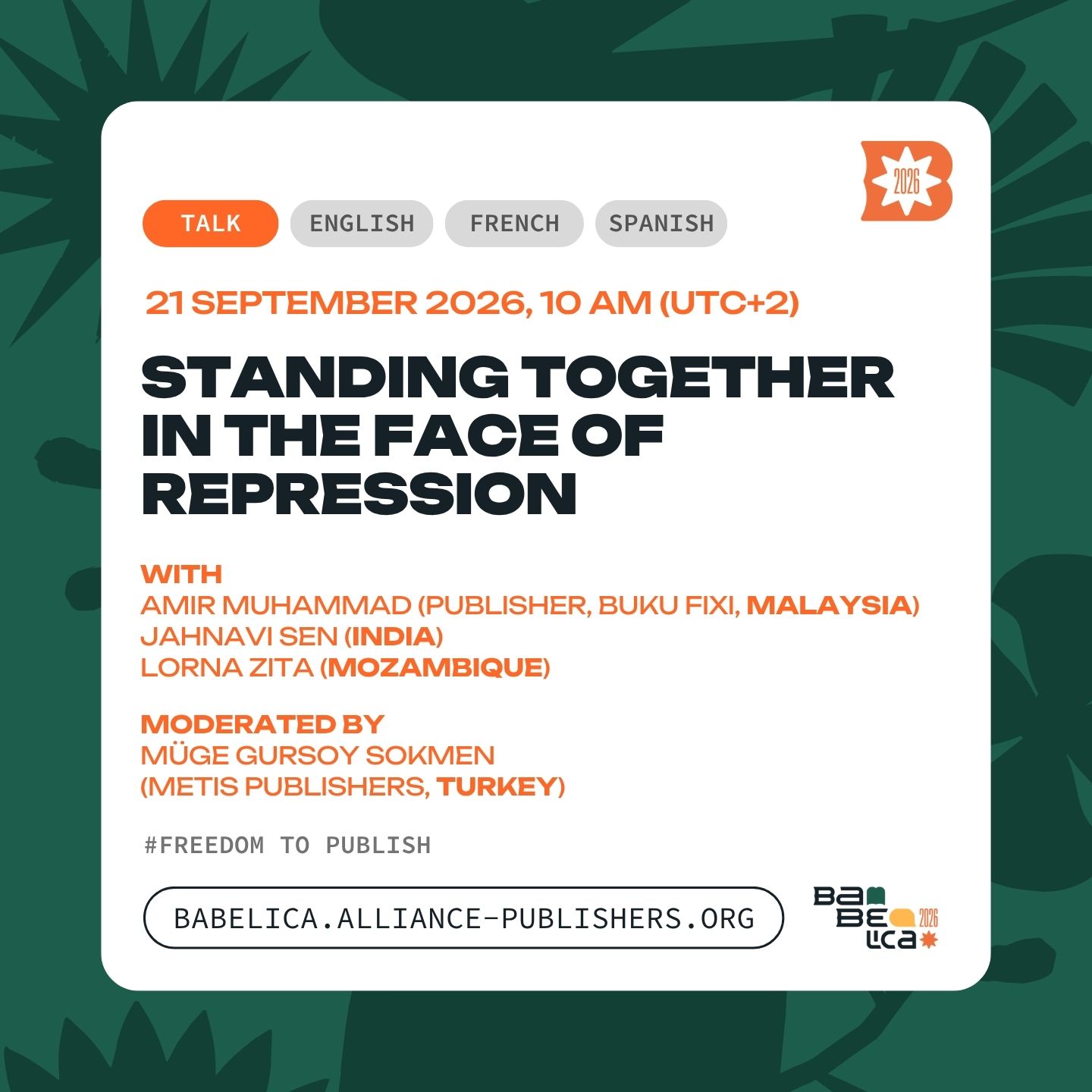
Jahnavi Sen, India Moderated by Müge Gursoy Sokmen, Turkey (Metis Publishers)
Amir Muhammad : “3 209 books are currently banned. It sounds like a lot but it means that there are millions that are not banned ! [...] We are acknowledging that censorship exists but we also are acknowledging that we have the right to talk about it.”
Lorna Zita : “We need to create a world where everyone can speak without fear. When we speak about repression, it is not only about stopping people to speak [...] when people be silenced, we lose important voice in the society.”
Jahnavi Sen : “An entire ecosystem knowing that everyone else also exists and continues to do that, it creates not just solidarity but also a sense of responsibility towards the other that you know. We have to hold this up for each other.”
Müge Gursoy Sokmen : “I’m coming from this country where we had a coup-d’état, a military takeover in Turkey in 1980 and that is why my publishing house was founded. We were students at that time but we wanted to continue talking about things that were important for us.”
This panel discussion took place during the 2026 edition of the Babelica Book Fair.
Overview
With authoritarianism on the rise, extremism and conflict gain ground, and the planet suffers. It is becoming increasingly difficult to see a way forward. In this context, how can we resist – and how can we hope ?
This issue gives a voice to 30 young authors, all under the age of 30, living in 30 different countries. From the small details of everyday life to grand, boundless dreams, their writings tell us where their resistance lies and how they live out their hopes.
It is these voices – from Nigeria and Ukraine, Afghanistan and Brazil, Palestine and Chile, Singapore and Guatemala… – that we invite you to engage with, giving us a glimpse of wonder.
Foreword by Karim Kattan
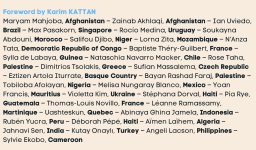
Authors :
Maryam Mahjoba, Afghanistan – Zainab Akhlaqi, Afghanistan – Ian Uviedo, Brazil – Max Pasakorn, Singapore – Rocío Medina, Uruguay – Soukayna Abdouni, Morocco – Salifou Djibo, Niger – Lorna Zita, Mozambique – N’Anza Tata, Democratic Republic of Congo – Baptiste Théry-Guilbert, France – Sylla de Labaya, Guinea – Nataschia Navarro Macker, Chile – Rose Taha, Palestine – Dimitrios Tsolakis, Greece – Sufian Massalema, Czech Republic – Eztizen Artola Iturrate, Basque Country – Bayan Rashad Faraj, Palestine – Tobiloba Afolayan, Nigeria – Melisa Nungaray Blanco, Mexico – Yoan Francis, Mauritius – Violetta Kim, Ukraine – Stéphana Dorval, Haiti – Pía Rye, Guatemala – Thomas-Louis Novillo, France – Léanne Ramassamy, Martinique – Uashteskun, Quebec – Abinaya Ghina Jamela, Indonesia – Rubén Yucra, Peru – Déborah Pépé, Haiti – Aïmen Laïhem, Algeria – Jahnavi Sen, India – Kutay Onaylı, Turkey – Angeli Lacson, Philippines – Sylvie Ekobo, Cameroon
All other information on this issue and the Bibliodiversité review can be found here. Bibliodiversité is co-published by Double ponctuation and the International Alliance of Independent Publishers.
‘Resist and Hope’ has received support from the Jan Michalski Foundation, to whom we extend our warmest thanks.
At a time when linguistic diversity is receiving unprecedented attention and faces challenges in AI, the IBBY–UNESCO Collection of Remarkable Books for Young Readers in Indigenous and Endangered Languages stands as a testament to the enduring value of languages as living expressions of knowledge, identity and imagination.
This joint initiative reflects the shared commitment of the International Board on Books for Young People (IBBY) and the United Nations Educational, Scientific and Cultural Organization (UNESCO) to place children and young readers at the heart of global efforts to safeguard and promote linguistic diversity.
“Now that we have entered the 21st century, it is difficult to dissociate the end from the means : what to say, and where to say it ? Thus, we find that many authors seeking to promote debate, creativity and critical thinking, justice and equality are published by large conglomerates with multiple editorial labels. Isn’t the transformative power of these works reduced to nothing when they plunge into the workings of the entertainment industry ? It is a fact that transnational corporations, whatever their field of action, are the very expression of the system that dominates us. By choosing them as publishers, do we not somehow leave the world of transformative ideas in the hands of those who lay the foundations of the model we criticise ? Doesn’t that strengthen the control of big capital over the word and our daily lives ? Moreover, how can we not question the cross-industry investment of the business groups that own publishing houses ? And, are these investments neutral ?”
In this open letter, independent publishers invite all the actors of the book industry to reflect with them on their practices and the impacts that result from them. In particular, they call on authors, academics and intellectuals to work on projects whose vocation is to transform the order of things and not to consolidate the status quo, to publish their works in independent publishing houses in their own countries, and to give preference to independent publishing houses when it comes to transferring foreign and translation rights.
As the world suffers the health, social and economic consequences of the pandemic, book ecosystems and independent publishing houses are further weakened and, for some, are trying to survive. If solidarity between creators and book professionals is one of the foundations of bibliodiversity, this solidarity is vital in the current context.
A label committed to the cultural, social, and political role of books and reading
‘Aware of our responsibility towards the future of our societies, the environment, and humanity ; convinced that only joint and united action will make it possible to change the situation and reverse the dynamics of concentration, destruction, and domination of some over others, the members of the International Alliance of Independent Publishers reaffirm their commitment to decolonial, ecological, feminist, free, social, and united publishing (Pamplona-Iruñea Declaration, 2021). Through this label, we pledge to put sustainability and bibliodiversity into practice in each of our books.’
The cultural, social and economic added value of independent publishers is often little known outside professionals in the book and reading ecosystem, and goes unnoticed by readers. Similarly, among independent publishers, there are different ways of carrying out editorial work, more or less aligned with the good practices of sustainability and bibliodiversity that the publishers of the International Alliance of Independent Publishers defend.
Against this backdrop, the Spanish-language network of the International Alliance of Independent Publishers has decided to use this label to “explain” to readers and stakeholders in the book trade why publishing with a committed independent publisher is different from publishing with a multinational.
The label highlights three areas of editorial work : ecological, decolonial, social and solidarity-based.
Three guidelines have been drawn up for each of them.
ECOLOGICAL
1. The book has been printed locally (in the country/region where the publisher works) in order to reduce the carbon footprint generated by transport from other latitudes. It also contributes to the development of the local economy.
2. The print run of the book has been adjusted as closely as possible to its commercial potential, thus avoiding overstocking, which leads to excess use of raw materials and an increase in stored resources.
3. No additional plastic materials have been used other than those required for the book in the climatic conditions in which it was printed, in order to protect the environment and the quality and durability of the book.
DECOLONIAL
1. The publishing house publishes works in minority/local languages, thereby promoting plurality of content, democratising access to reading and encouraging the circulation of ideas beyond hegemonic languages.
2. The publishing house co-publishes with other independent publishers, in its own country or in other countries with the same language, in order to promote joint work, solidarity and the strengthening of local ecosystems.
3. The publishing house is a member of a local and/or international association of independent publishers working to strengthen bibliodiversity.
SOCIAL AND SOLIDARITY-BASED
1. For equal working hours, the pay gap within the publishing house will not exceed a scale of 1 to 3, in order to guarantee fair pay between employees.
2. Copyright is respected in accordance with current regulations, and a fair income has been agreed between the author and the publisher.
3. The publication promotes access to books beyond the logic of the market, encouraging the circulation of ideas by establishing a fair price that seeks to determine the most economic value possible for the work, taking into account the durability of the book and the editorial catalogue.