












Public Book Policies

Public book policies are a set of measures, standards, frameworks and laws that structure and support the book field in a given country : they must strengthen a given country’s book sector, help to support local production, the dissemination and access of all to the book, in particular through the implementation of adequate regulatory and tax measures and the multiplication of reading spaces (public libraries for example). Public book policies need to be developed and implemented with all book professionnals, in each country. It is also necessary for these national policies to be extended by regional and international policies.

Resources

Giving new value to intellectual work

Piracy, neoliberal pressure and the absence of public reading policies are among the factors that have a negative impact on books and intellectual work. This workshop aims not only to set out the issues leading to the « casualisation » of intellectual work, but also to present possible solutions.

Babelica is the International online Book Fair of Independent Publishing, conceived and organised by the network of publishers of the International Alliance of Independent Publishers. All the information about the 2023 edition can be found at babelica.alliance-publishers.org.

Partager l'article

Translation and publishing in Arabic : spotlight on the challenges ahead

The question of translation is a real issue in the publishing ecosystem of the Arab world : indeed, the absence of translators of some languages obliges translators to translate into an intermediary language ; given the high costs this represents, it is sometimes difficult to be sure a translation conforms to the original text. Sometimes the publishing projects of an author or series of books do not correspond with the visions and interests of translators, which leads to lack of understanding, or even obstacles for the translation of some texts. There are numerous challenges, but possible actions will also be put forward at this round table discussion, in particular the creation of training institutions.

Babelica is the International online Book Fair of Independent Publishing, conceived and organised by the network of publishers of the International Alliance of Independent Publishers. All the information about the 2023 edition can be found at babelica.alliance-publishers.org

Partager l'article

Mapping public book policies in the Arab world

In 2017, publishers who are members of the Alliance along with academics and experts united to collectively produce some research on Public Book Policies in Latin America and in Sub-Saharan Africa. This has since been converted into a unique digital, graphic and interactive tool for informing and centralising data on the public support systems for books and reading in 22 countries.

In 2024, the International Alliance of Independent Publishers, thanks to the support of Open Society Foundation, extends this project to the Arab world for a better understanding of public authorities’ commitment to books and reading in the different countries of the Arab world. To this end, data is collected in 10 countries based on a common questionnaire. The data will then be presented on the dedicated website for each country. A cross-sectional analysis will be carried out on the basis of these data ; the Alliance is looking for an author to draft this cross-sectional analysis.

Deadline to apply (equipe@alliance-editeurs.org) : 31 May 2024

This unique and important work ! The mapping and the analysis will be presented publicly in December 2024 or January 2025 to professionals and representatives of public authorities in the countries.

Read more here (in Arabic) / see on the right the English version for download

Partager l'article

Brief Manual of Best Practices for Public Book Procurement

“It is important to understand the key role that the public procurement of books plays–similar to that of roads in a country’s development–and the related impacts of these actions on the ecosystem of books, culture, and education.

In purchasing books and socializing the processes of reading, the state’s actions may have numerous impacts. The selection of books is not only a question of quality and price, nor is it a simple technical process or an isolated action.”

This document is based on the Brevísimo manual de buenas prácticas para las compras públicas de libros (print and digital) that was included in the work of the Comisión de Compras Públicas de la Política Nacional de la Lectura y el Libro 2015-2020 (Chile), prepared by Paulo Slachevsky, coordinator of the commission. We are grateful to Germán Gacio Baquiola for his critical feedback and contributions.

Read the Manual

Partager l'article

Manual de buenas prácticas para las compras públicas de libros

“Una buena política de adquisición de libros por parte del Estado tiene múltiples y significativos impactos en el desarrollo cultural, social, económico y político de un país […] Por todo ello es tan importante mejorar, incrementar, trasparentar, desconcentrar y fortalecer la presencia de autoras/es y editoriales locales en los procesos de compras públicas de libros. También analizar, revisar y diversificar constantemente las áreas en que se centran los gastos, como los libros de textos que concentran generalmente gran parte del gasto público en libros.”

Este documento reproduce, con algunas modificaciones, el Brevísimo Manual de buenas prácticas para las compras públicas de libros (en papel y en formato digital) que fue incorporado al trabajo de la Comisión de Compras Públicas - Política Nacional de la Lectura y el Libro 2015-2020 (Chile), realizado por Paulo Slachevsky (LOM Ediciones, Chile) como coordinador de la Comisión. Este manual ha sido revisado por Germán Gacio Baquiola (Editores independientes de Ecuador).

Leer el manual

Partager l'article

VAT Changes for Books in Brazil, August 2020

Read here the IPA (International Publishers Association) support, and here the manifesto published by the Brazilian actors, to defend the book in Brazil.

Partager l'article

Laws, public policies, institutions and support systems for books and reading in Latin America : an unpublished study (September 2019) !

Analysis of data collected in 10 countries from independent publishers and public actors, by Andrés E. Fernández Vergara (University of Chile)

This article, written in Spanish, offers a regional analysis of public policies for the development of books and reading in Spanish-speaking Latin America, from the point of view of 53 actors in the book world from 10 different countries. It takes into account the similarities and differences that exist from one country to another in the region : on the one hand, there are complex networks of institutions and book promotion mechanisms ; on the other hand, there is no national policy or strategic objective. The actors interviewed highlight the difficulties they encounter in their sector today : market concentration, piracy, lack of support for indigenous languages, etc. These are all dangers that threaten bibliodiversity in the region.

Contents :

  • Methodology
  • Censorship and content control
  • Laws, public policies and regulatory mechanisms for books and reading
  • Institutions and organisations working in the fields of books and reading
  • Direct support and assistance for books and reading
  • Copyright Legislation
  • Organisation of the profession
  • Conclusion

This analysis is to be found in a special issue of the Bibliodiversity Journal on “Public book policies” available in paper and digital versions (in French).

See also the analysis on “Public book policies in sub-Saharan Africa and Madagascar” by Luc Pinhas, published in September 2019.

To complement these analyses, see the mapping of public policies and in-country support mechanisms here : publicbookpolicies.alliance-editeurs.org

Data collection in the 11 countries of sub-Saharan Africa and Madagascar as well as in Latin America, cross-sectional data analyses and online mapping were supported by the Fondation de France and the SDC Switzerland.

Partager l'article

Public book policies in sub-Saharan Africa and Madagascar, an unpublished study (September 2019) !

Cross-sectional analysis of data collected in 12 countries, by Luc Pinhas, University of Paris 13 Villetaneuse (France)

In a comprehensive cross-sectional study that enriches our knowledge of public book policies in French-speaking sub-Saharan Africa, Luc Pinhas discusses the similarities and differences that exist between 12 countries in the region. While some very interesting developments for local book production and the local book chain should be acknowledged – cf. the preference given to local actors by the Ivorian law of 2015 – the legislative and regulatory frameworks would certainly benefit from being strengthened to support and strengthen the local book economy.

Contents :

  • Preamble
  • Methodology
  • Introduction
  • Legal framework
  • Taxation and market regulation
  • Professional organisation
  • Administrative organisation
  • Direct support for the book
  • Conclusion

This analysis is to be found in a special issue of the Bibliodiversity Journal on “Public book policies” available in paper and digital versions (in French).
See also the analysis on “Public book policies in Latin America”, published in September 2019.

To complement these analyses, see the mapping of public policies and in-country support mechanisms here : publicbookpolicies.alliance-editeurs.org

Data collection in the 11 countries of sub-Saharan Africa and Madagascar as well as in Latin America, cross-sectional data analyses and online mapping were supported by the Fondation de France and the SDC Switzerland.

Partager l'article

80 recommendations & tools in support of bibliodiversity

These 80 recommendations are built on the principles upheld in the 2014 International Declaration of independent publishers, an important document promoting bibliodiversity, signed on September 20th 2014, by more than 400 independent publishers from 45 countries.

They raise the necessary prerequisites, divided by themes, for the development, maintenance and strengthening of bibliodiversity in concerned countries. Some recommendations are accompanied by tools and projects (existing or to be developed in the context of the 2015-2016 Alliance programme of activities), enabling a practical implementation of independent publishers’ proposals.

Contents of the 80 recommendations & tools in support of bibliodiversity :

* Public policies safeguarding bibliodiversity
* Proposals and actions supporting digital bibliodiversity
* The Amazon system, a threat to bibliodiversity ?
* Essential measures for publishing in local and national languages
* Methods for rethinking book donations
* Proposals and actions to develop solidarity publishing partnerships
* Activities to strengthen diversity in youth publishing

For all book actors to take ownership of these recommendations and tools, we invite you to contact us with your comments, suggestions, ideas, and proposals that could enhance and strengthen this document.

Partager l'article

Public book policies

Contact the Alliance team to get a free digital version of this issue dedicated to public book policies.

Publication : June 2019
The Bibliodiversité review is copublished by Double ponctuation and the International Alliance of independent publishers.
See other issues of Bibliodiversité review here : “Self-publishing” ; “Committed publishing”…

Overview of the issue :
From censorship to safeguarding, public initiatives in the book sector are varied.
This issue proposes academic articles, professional’ views and two previously unpublished regional analyses (sub-Saharan Africa and Spanish-speaking Latin America), taking us from Russia to Switzerland, via Syria, Lebanon, Tunisia, Morocco, Quebec, France and Argentina.
All contributions seek an answer to this question : does the intervention of public authorities support editorial diversity ?

Contents of the ‘Public book policies issue’ :

  • “Introduction : action taken by public authorities to support books”, by Étienne Galliand, Editor-in-Chief of Bibliodiversity Journal
  • “Federalism and cohesion – New book policies in Switzerland”, by Carine Corajoud, historian (Switzerland)
  • “A relative autonomy – A comparative analysis of the room for manoeuvre
    in public publishing in France”, by Hélène Seiler-Juilleret, École des hautes études en sciences sociales (Higher School of Social Sciences, France)
  • “Negotiating control, promoting reading – Independent publishers and the Russian State in the 2010s”, by Bella Ostromooukhova, Paris Sorbonne University (France and Russia)
  • “Morocco : escheated books – The shortcomings in state involvement in the books and written word sector”, by Anouk Cohen, CNRS (France and Morocco) and Kenza Sefrioui, Ph.D. in comparative literature, literary critic and publisher (Morocco)
  • “Government policy on books in Tunisia” – A publisher’s view, by Nouri Abid, Med Ali publishers (Tunisia)
  • “Government policy on books in Syria” – A publisher’s view, by Samar Haddad, Atlas Publishing (Syria)
  • “Government policy on books in Lebanon” – A bookseller’s view, by Michel Choueiri, bookseller (France and the United Arab Emirates)
  • “Government policy on books in sub-Saharan Africa and Madagascar. A cross-sectional analysis of data collected in 12 countries”, by Luc Pinhas, University of Paris 13 Villetaneuse (France)
  • “Publishing and public authorities : the Quebec case – Or the influence of public action on editorial independence ?”, by Pascal Genêt, Sherbrooke University (Quebec-Canada)
  • “Laws, public policies, institutions and measures to support books and reading
    in Latin America – An analysis of data gathered in 10 countries”, by Andrés E. Fernández Vergara (University of Chile)
  • “From culture towards business – An analysis of a state support programme
    for local publishing in Buenos Aires : Opción Libros”, by José de Souza Muniz Jr., Federal Centre for Technological Education, Minas Gerais (Brazil)

Partager l'article

Mapping public book policies

Mapping public book policies in the Arab world

In 2017, publishers who are members of the Alliance along with academics and experts united to collectively produce some research on Public Book Policies in Latin America and in Sub-Saharan Africa. This has since been converted into a unique digital, graphic and interactive tool for informing and centralising data on the public support systems for books and reading in 22 countries.

In 2024, the International Alliance of Independent Publishers, thanks to the support of Open Society Foundation, extends this project to the Arab world for a better understanding of public authorities’ commitment to books and reading in the different countries of the Arab world. To this end, data is collected in 10 countries based on a common questionnaire. The data will then be presented on the dedicated website for each country. A cross-sectional analysis will be carried out on the basis of these data ; the Alliance is looking for an author to draft this cross-sectional analysis.

Deadline to apply (equipe@alliance-editeurs.org) : 31 May 2024

This unique and important work ! The mapping and the analysis will be presented publicly in December 2024 or January 2025 to professionals and representatives of public authorities in the countries.

Read more here (in Arabic) / see on the right the English version for download

Partager l'article

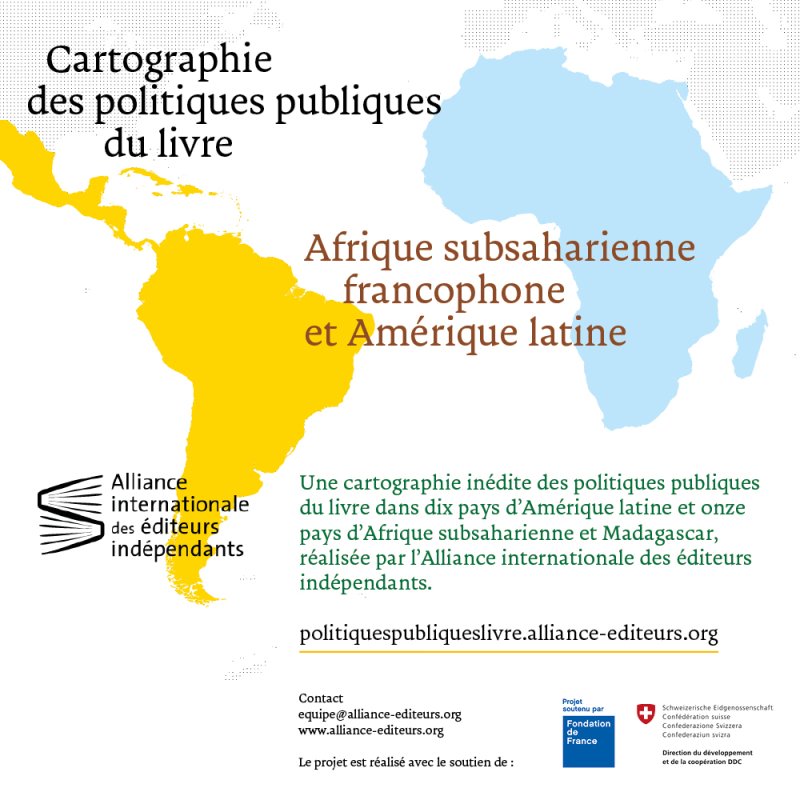
Mapping public book policies in Latin America and Sub-Saharan Africa and Madagascar

An unprecedented mapping of policies supporting reading and books in 22 countries, which can be consulted and downloaded online : publicbookpolicies.alliance-editeurs.org

Arising from the observation of the lack of data on public book policies in regions where the member publishers of the Alliance operate, particularly in Latin America and sub-Saharan Africa, the public book policy mapping project is the result of several years of collaboration between book and publishing professionals, academics and experts on public book policies. It relies first and foremost on the investment and involvement of the Alliance’s member publishers, who are its primary actors. It is one of the flagship projects of the Bibliodiversity Observatory.

The mapping proposes several items : one entry per country (country fact sheets listing existing mechanisms for public support for books at the national level) ; a regional entry (comparative data through cross-cutting analyses). It is interactive and evolving : the fact sheets presenting the institutions and national public book policies can be amended and modified as the systems evolve. This mapping is thus intended to be extended to new countries in both regions, or even to integrate a new region in the long term (the Arab world in particular). For now, the mapping exists only in Spanish and French for lack of financial means to carry out a translation into English. The Alliance hopes to find the necessary funds to translate the mapping into English soon.

The objectives of the mapping are to :
• make available data on the public book policies of the respective countries ;
• offer an overview of public book policies, freely accessible, consultable and reusable by professionals and public authorities ;
• promote dialogue and exchanges between public authorities and publishers ;
• develop advocacy tools for independent publishers ;
• contribute to the establishment and consolidation of public book policies in developing countries (among others, for a greater circulation of books and ideas, for the appropriation of digital tools by book professionals, for balanced exchanges between North and South) ;
• affirm the role of civil society (book professionals and particularly independent publishers) in the development and implementation of public book policies.

JPEG - 457.1 kio

The Alliance warmly thanks the partners of this project : the Fondation de France and the Swiss SDC.

See the complementary issue of the Bibliodiversity journal “Public book policies”.

Press release

If you have any questions, please do not hesitate to contact the Alliance team at : equipe@alliance-editeurs.org

Partager l'article

Recommander cette page