English

The Alliance

Objectives 2022-2025

1/ The Alliance, a place for experimentation and reflection through the Bibliodiversity Observatory

  • Continue the analyses, reflections and advocacy via the thematic working groups set up during the 2014 Conference and set up new working groups on the themes and issues discussed during the 2021 Conference
  • Providing tools and documenting international independent publishing

2/ The Alliance, a space for collaboration and sharing

  • Share practices and know-how (on regional, national or even international levels, depending on the needs expressed) between publishers
  • Meet and strengthen the flow of exchanges

3/ The Alliance, a tool for promoting independent publishing and the circulation of books

  • Encourage the visibility and promotion of independent publishing
  • Promote the circulation of works and productions of independent publishing houses

4/ The Alliance, a laboratory of alternative editorial practices

5/ The Alliance, an evolving governance and operation

  • REthink
  • Get involved

Partager l'article

Pamplona-Iruñea Declaration ’for independent, decolonial, ecological, feminist, free, social and solidarity-based publishing’

Gathered in the city of Pamplona-Iruñea from 23 to 26 November 2021 at the fourth International Conference of Independent Publishers, organised in partnership with EDITARGI (Association of Independent Publishers of Navarre), we, the publishers of the International Alliance of Independent Publishers (IAIP), reaffirm our commitment to :

  • the cultural, social and political character of books and reading ;
  • the democratisation of books in our societies ;
  • reading as an emancipatory practice that strengthens the critical thinking of citizens and stakeholders within their society.

Read the full Declaration here :

This Declaration is in line with the discussions and work of the International Alliance of Independent Publishers, in particular the Declarations of 2003, 2007 and 2014 and the 80 recommendations in favour of bibliodiversity. It will be complemented by a Guide to Good Practice (collective work in progress, for publication in the first half of 2022).

The round-table discussions of the Conference are available in replay on the Alliance’s YouTube channel.

Partager l'article

For a decolonial, ecological, feminist, free, social and solidarity-based independent publishing : preliminary conclusions of the Pamplona-Iruñea Conference and perspectives !

Illustrations and video : Mariette Robbes (https://marietterobbes.fr/)

The International Conference of Independent Publishers held in Pamplona-Iruñea brought together more than 100 book professionals from 40 countries and was attended by more than 300 participants connected to the Babelica platform.
6 round-table discussions and 3 collective workshops in 4 languages of communication ; B2B meetings ; closing speeches by Vandana Shiva and Djaïli Amadou Amal...

The round-table discussions of the Conference are available in replay on the Alliance’s YouTube channel.

The conclusions of the Conference are currently being drafted and will be available on the Alliance’s website in early 2022. They will present the highlights of the Conference, the proposals and recommendations of the independent publishers for REthinking, and the Alliance’s perspectives for the period 2022-2025.

The declaration of the Conference “For an independent, decolonial, ecological, feminist, free, social and solidarity-based publishing” is also being finalised (proofread by the different networks of the Alliance, in several languages). This declaration will be completed by a guide of good practices - the first drafts of this guide were elaborated during the Conference and are the object of a collective work within the Alliance, for publication during the first quarter of 2022.

The photos and press review of the Conference can already be found here !

The Alliance would like to thank once again all the partners of the Conference (see here) and especially the association EDITARGI, co-organiser of this unique meeting !

Partager l'article

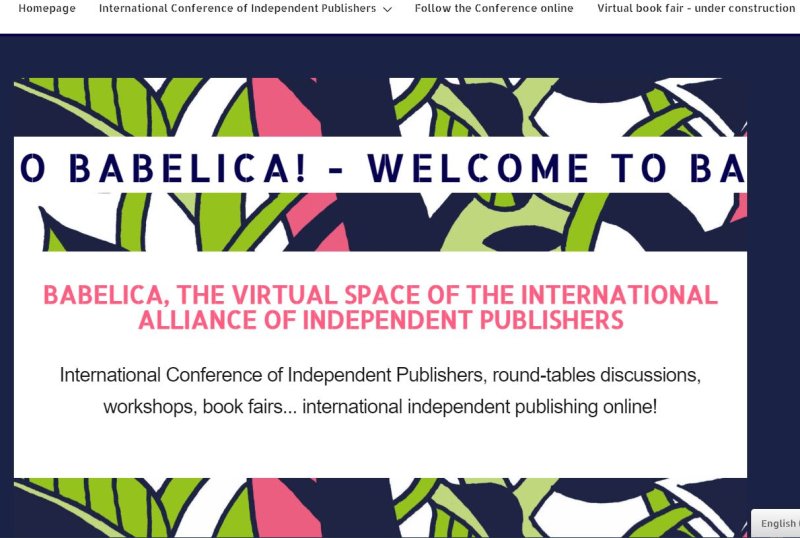
Follow the International Conference of Independent Publishers in Pamplona (23-26 November, 2021) on Babelica, the Alliance’s virtual space

International Conference of Independent Publishers, round tables and workshops : the international independent publishing online on Babelica !

All information about the Pamplona Conference is available on Babelica in English, French, Spanish and Basque.

JPEG - 137.9 kio

Partager l'article

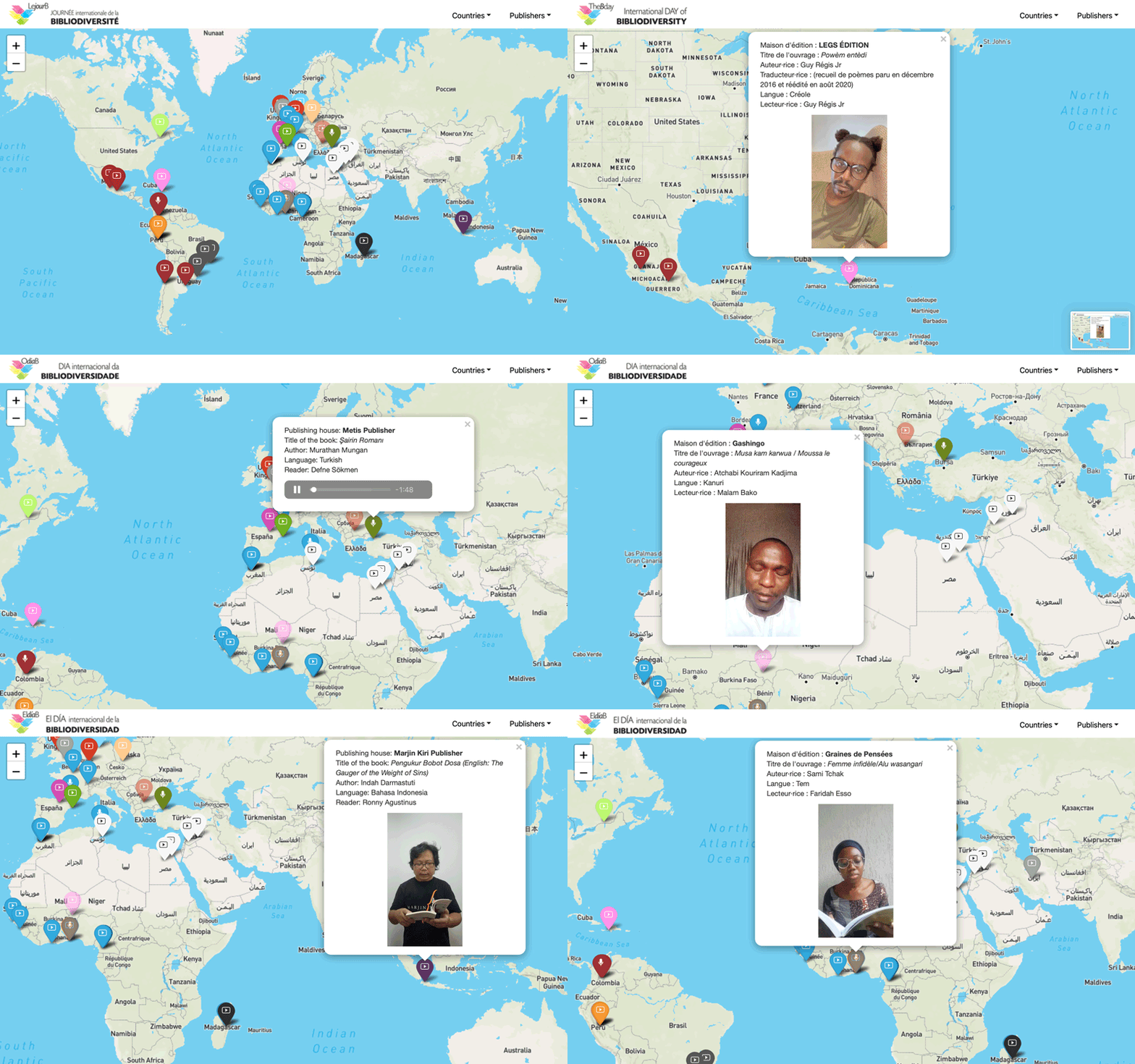
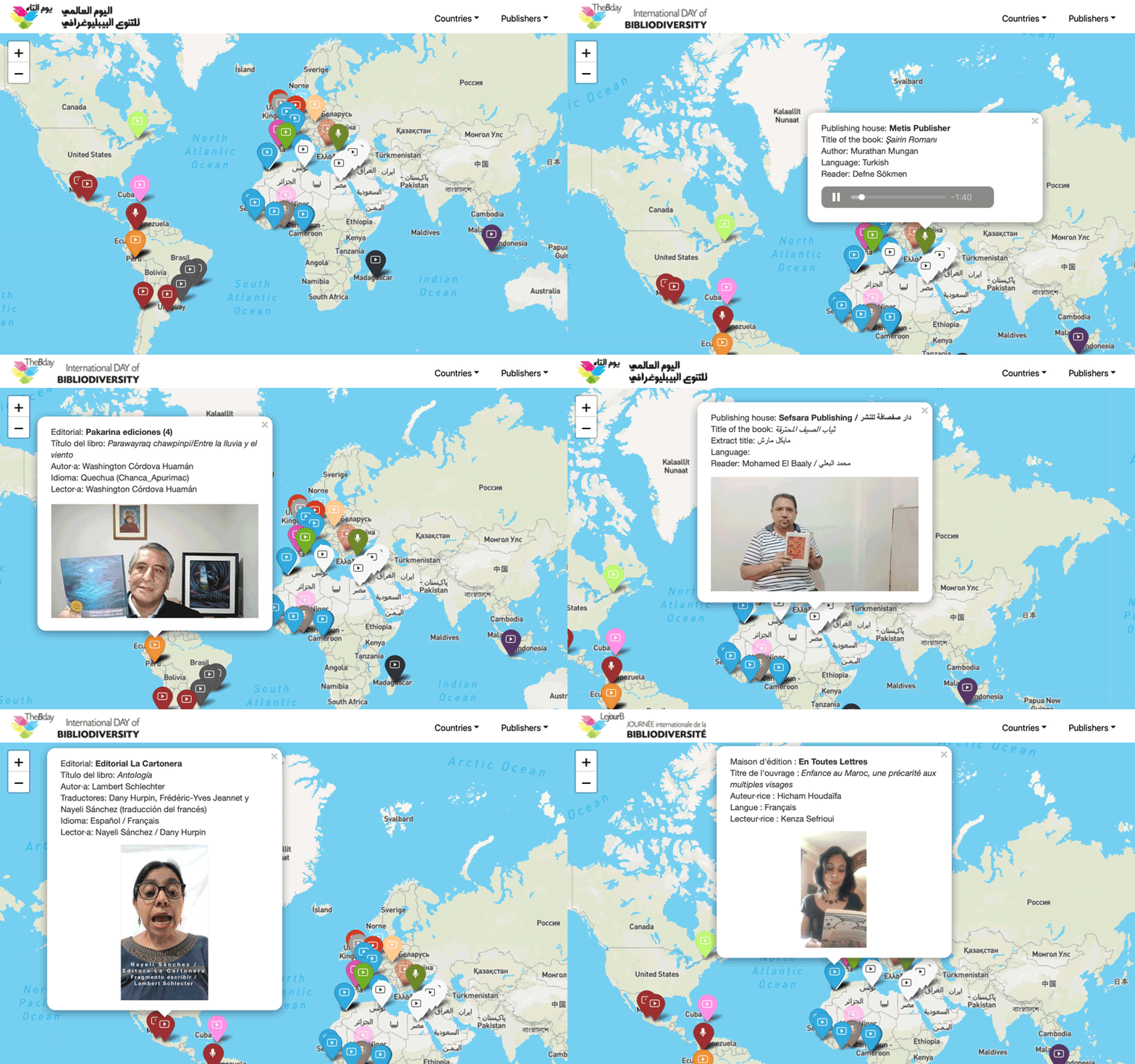
A literary and multilingual sound card : Happy B-Day and happy 20th birthday to the Alliance !

On 21 September, we are celebrating bibliodiversity and also the 20th birthday of the Alliance !

The publishers are offering you a literary world tour in more than 30 countries : 45 readings in 25 languages to listen to and watch here !

GIF - 1.3 Mio

GIF - 945.9 kio

A big thank you to all of you for this gift ; thanks also to Naima Éditions for making this map.

Partager l'article

Children’s Books Hotlist

The Children’s Book HotList highlights children’s books from independent publishers in Africa, Latin America and Europe. It is launched during the 2021 Bologna Children’s Book Fair, on June 14.

JPEG - 354.4 kio

Comprising books from 16 countries, 36 publishing houses and 14 categories, this HotList represents the richness and diversity of independent publishing for youth and children’s literature.

You can find a book by searching its country, publisher or literary genre. If you are interested in a book, please do get in touch with its publisher.

We wish you a great discovery !

Partager l'article

The Arabic Language Network expresses its strong condemnation of the forced deportation campaign of Palestinians from the « Sheikh Jarrah neighborhood » in East Jerusalem, May 11, 2021

The Arabic Language Network of the International Alliance of Independent Publishers expresses its strong condemnation of the forced deportation campaign of Palestinians from the « Sheikh Jarrah neighborhood » in East Jerusalem, and the systematic violence and persecution led by the government of Benjamin Netanyahu against Jerusalemites in particular and the Palestinians in general in restoring the « apartheid » policies that the world seeks to overcome.

Read here the entire open letter from the Arabic Language Network of the Alliance.

Partager l'article

2021 programme of the Alliance and 2020 highlights

Read here the 2021 programme of the Alliance and the 2020 highlights !

Partager l'article

Des fourmis dans la bouche

Auteur(s) : Khadi HANE
Pays de parution : Algérie, Burkina Faso, Cameroun, Côte d’Ivoire, Guinée, Mali, Maroc, Togo
Langue(s) : français
Prix : 50 dirhams marocains ; 750 dinars algériens ; 45 000 francs guinées ; 3 000 FCFA

Gratteurs d’écailles dans une poissonnerie, vendeurs ambulants de montres de pacotille ou de statuettes en bois, journaliers payés au noir pour décharger des sacs d’un camion, hommes à tout faire d’un commerçant pakistanais qui revendait des pots de crème à l’hydroquinone censés procurer aux nègres l’éclat d’une peau blanche, la leur ne faisant plus l’affaire. Sur le marché Dejean, on trouvait de tout...

Née au Mali, Khadîja élève seule quatre enfants à Paris, dans le quartier de Château-Rouge. Pétrie de double culture, musulmane mais le doute chevillé au corps, elle se retrouve exclue de sa communauté du fait de sa liaison avec Jacques, le père de son fils métis.
Cercle après cercle, depuis ses voisines maliennes jusqu’aux patriarches du foyer Sonacotra et à ses propres enfants, Khadîja passe en jugement. Mais cette absurde comparution, où Africains et Européens rivalisent dans la bêtise et l’injustice, réveille en elle une force et un humour inattendus.
Tableau intense de Château-Rouge, Des fourmis dans la bouche est porté par une écriture inventive au ton très singulier, fondée sur la double appartenance. Un roman qui dit la difficile liberté d’une femme africaine en France.

Khadi Hane est née à Dakar en 1962. Venue en France pour poursuivre ses études, elle vit aujourd’hui à Paris. En 1998, elle publie son premier roman, Sous le regard des étoiles (Nouvelles éditions africaines du Sénégal). Suivent, entre autres, Le collier de paille (2002), Ma sale peau noire, Il y en a trop dans les rues de Paris (2005), Des fourmis dans la bouche (Denoël, 2011) pour lequel elle reçoit le Prix Thyde Monnier 2012 de la Société des Gens de lettres, et Demain, si Dieu le veut (Joëlle Losfeld, 2015).

Coéditeurs  : Apic (Algérie), Eburnie (Côte d’Ivoire), Ganndal (Guinée Conakry), Graines de Pensées (Togo), Le Fennec (Maroc), Proximité (Cameroun), Sankofa & Gurli (Burkina Faso) et Tombouctou (Mali)
Date de publication de la version panafricaine : 2021, 11,5 X 19 cm
Édition première en France : Éditions Denoël, 2011
Maquettage pour le collectif de maisons d’édition : éditions Apic (Algérie)
Choix de la couverture et corrections : le collectif de maisons d’édition
Impression commune en Algérie pour l’Algérie, la Guinée, le Togo, le Burkina Faso et le Mali. Transport des exemplaires d’Algérie vers le Mali par avion puis dispatch dans les différents pays par voie routière.
Impressions locales directement dans les pays pour la Côte d’Ivoire, le Maroc et le Cameroun.

Cette coédition solidaire porte le label Le livre équitable.

Collection Terres solidaires

Créée en 2007, la collection « Terres solidaires » est une expérience collective. Elle propose des textes littéraires d’autrices et auteurs africain.e.s, édités par un collectif de maisons d’édition en Afrique francophone. Grâce au principe de la coédition solidaire, les textes circulent, sont disponibles et accessibles pour les lecteurs africains ; l’écosystème du livre local est préservé et renforcé.
La collection « Terres solidaires » est soutenue par l’Organisation internationale de la Francophonie (OIF).

Partager l'article

Bibliodiversity Observatory

« ’It’s a real battle’ : African authors fight for publishing independence », The Guardian, 2020

“Francophone African books are still very often published by French imprints, which can make them hard to get at home. But there is a growing push for change...

When Cameroonian author Daniel Alain Nsegbe first saw his debut novel for sale in his home city of Douala, the price was so high “you would have to ask someone to stop eating for two days in order to buy the book”. It was around 16,000 CFA francs (£20) ; the average monthly salary in Douala is £150. The book, Ceux qui sortent dans la nuit (Those Who Go Out at Night) was published by Grasset, a French imprint. [...]”

Read here the article by Olivia Snaije, published in The Guardian, 14 May 2020.

Partager l'article

Mapping public book policies in Latin America and Sub-Saharan Africa and Madagascar

An unprecedented mapping of policies supporting reading and books in 22 countries, which can be consulted and downloaded online : publicbookpolicies.alliance-editeurs.org

Arising from the observation of the lack of data on public book policies in regions where the member publishers of the Alliance operate, particularly in Latin America and sub-Saharan Africa, the public book policy mapping project is the result of several years of collaboration between book and publishing professionals, academics and experts on public book policies. It relies first and foremost on the investment and involvement of the Alliance’s member publishers, who are its primary actors. It is one of the flagship projects of the Bibliodiversity Observatory.

The mapping proposes several items : one entry per country (country fact sheets listing existing mechanisms for public support for books at the national level) ; a regional entry (comparative data through cross-cutting analyses). It is interactive and evolving : the fact sheets presenting the institutions and national public book policies can be amended and modified as the systems evolve. This mapping is thus intended to be extended to new countries in both regions, or even to integrate a new region in the long term (the Arab world in particular). For now, the mapping exists only in Spanish and French for lack of financial means to carry out a translation into English. The Alliance hopes to find the necessary funds to translate the mapping into English soon.

The objectives of the mapping are to :
• make available data on the public book policies of the respective countries ;
• offer an overview of public book policies, freely accessible, consultable and reusable by professionals and public authorities ;
• promote dialogue and exchanges between public authorities and publishers ;
• develop advocacy tools for independent publishers ;
• contribute to the establishment and consolidation of public book policies in developing countries (among others, for a greater circulation of books and ideas, for the appropriation of digital tools by book professionals, for balanced exchanges between North and South) ;
• affirm the role of civil society (book professionals and particularly independent publishers) in the development and implementation of public book policies.

JPEG - 457.1 kio

The Alliance warmly thanks the partners of this project : the Fondation de France and the Swiss SDC.

See the complementary issue of the Bibliodiversity journal “Public book policies”.

Press release

If you have any questions, please do not hesitate to contact the Alliance team at : equipe@alliance-editeurs.org

Partager l'article

Publishing & the Book in Africa : A Literature Review for 2019, by Hans M. Zell, 2020

Publishing & the Book in Africa : A Literature Review for 2019
The fifth in a series of annual reviews of select new literature in English that has appeared on the topic of publishing and the book sector in sub-Saharan Africa. Extensively and critically annotated and/or with abstracts, the present list brings together new literature published during the course of 2019, a total of 156 records.

Read the pre-print version here.

The final print/online version to be published in The African Book Publishing Record, vol. 45, issue 2 (May 2020).

Reprinted with permission of the author.
Copyright © Hans Zell Publishing Consultants 2019

Partager l'article

Indigenous publishing in sub-Saharan Africa : A chronology and some landmarks by Hans M. Zell, 2019

This chronological timeline sets out some of the key dates, events, and landmarks in the history and development of indigenous publishing in Sub-Saharan Africa. It also includes details of the major conferences, meetings or seminars on African publishing, held in Africa or at venues elsewhere, since 1968. An earlier version of this chronology first appeared in The African Publishing Companion : A Resource Guide, and has now been updated through to the period up to 2019, and considerably expanded to also include publication of a number of benchmark studies, conference proceedings, journals, and reference resources on the African book world.

Read here the pre-print version on Academia.edu, 21 October 2019.

Final version, to be published in African Research & Documentation. Journal of SCOLMA (The UK Libraries and Archives Group on Africa), no. 136 (2019)

Reprinted with permission of the author.
Copyright © Hans Zell Publishing Consultants 2019

Partager l'article

Minority languages / Coordinated by Nathalie Carré and Raphaël Thierry

Coordinated by Nathalie Carré (Institut National des Langues et Civilisations Orientales, Inalco) and Raphaël Thierry (independent researcher)

Publication : 2020

Contact the Alliance team to get a free digital version of this issue.

JPEG - 541.1 kio

Bibliodiversité review is co-published by Double ponctuation and the International Alliance of Independent Publishers.

See all the other issues of the review here (“Public book policies”, “Self-publishing”, “Publishing and commitment”, “Translation and Globalization”...)

Presentation
More than half of the languages spoken in the world are in danger of disappearing ; if nothing is done, UNESCO estimates that 90% of languages will have disappeared in the course of this century. Languages are an essential part of a people’s culture, yet they are much more than just a tool for communication ; they offer a unique view of the world and of the people who live in it. What can the publishing sector do – and is already doing – to help preserve and sustain these minority languages ? This book attempts to answer this question through academic articles and testimonies of book professionals who, together, propose a novel approach to the subject.

In the light of their publications, the book analyses the situation of several minority languages - Haitian Creole, Corsican, Innu, Yiddish, Kikuyu, Basque, Malagasy, Náhuatl, etc. and shows that solutions are possible when the actors in the book system are mobilised.

Summary :

  • Publishing in minority languages – On diversity of publishing languages in a
    globalized context / by Nathalie Carré (Inalco, France) and Raphaël Thierry
    (independent researcher, France)
  • Creole publishing in Haiti – Obstacles, initiatives and development prospects /
    by Sandie Blaise, Duke University (United States)
  • The spread of Yiddish poetry in German speaking world – The case of bilingual editions / by Caroline Puaud, Paris Sorbonne University
  • Write and publish in Madagascar – How to reach the world ? / by Dominique Ranaivoson, University of Lorraine (France)
  • Make minority languages dialogue (online) – The example of intergenerational collaboration in East Africa / by Pierre Boizette, Paris-Nanterre University (France)
  • Normativity, diversity and dynamics of creation in the contemporary Basque literary field – Study of its operating trends through the literary trajectory of Eñaut Etxamendi / by Itziar Madina Elguezabal, Bordeaux-Montaigne Doctoral school (France)
  • Locate, catalog, make visible – The place of minority languages in collections of the University Library for Languages and Civilizations Studies (BULAC) / Interview with Marine Defosse, Soline Lau-Suchet and Nicolas Pitsos, librarians at BULAC (France)
  • As long as the language circulates, we will have books to produce” / interview with Bernard Biancarelli (Albiana Publishing, Corsica/France)
  • Publishing must grow the world” – Mémoire d’encrier and the languages of the world / interview with Rodney Saint-Éloi, Mémoire d’Encrier Publishing (Quebec / Canada)
  • Saving a language is a task for all of us” / by María Yolanda Argüello Mendoza, Magenta editions (Mexico)
  • Public book and reading policies for indigenous languages in Chile. Intervention (updated in 2020) in the Parliament of Books and Speech / by Paulo Slachevsky, Lom Ediciones (Chile)
  • Save, transmit – An example of transcription-translation from oral literature
    of some Vietnam’s peoples / by Mireille Gansel, translator, writer
  • PEN’s commitment to Linguistic Rights – The importance of writing, publishing and reading in marginalized languages / interview with Peter McDonald (University of Oxford) and Carles Torner (PEN International), July 2018, Oxford and London

Partager l'article

“Terres solidaires” collection

The “Terres solidaires” collection was created in 2007, to strengthen the circulation of African literature in the Francophone space. Publishing houses that contribute to the collection are based in sub-Saharan Africa and in North Africa. Initially created to republish books written by African writers published in France and make them accessible to an African readership through the solidarity co-publishing process, it is now republishing books originally appearing on African publishers’ lists. Such is the case with Munyal, les larmes de la patience, by Djaïli Amadou Amal, the 13th title of the collection, originally published in 2017 by Proximité publishing, based in Yaoundé, Cameroun.

Publishers select texts and work in close collaboration throughout the editorial process. The principle of a selling price adapted to the buying power of the readership (on average 3 500 FCFA, or 5 Euros) remains one of its pillars.

Read more here...

Partager l'article

Digital Lab

The Digital Lab was created by the International Alliance of Independent Publishers to support independent publishers in their activities, reflections and digital practices. As a space of reflection, exchanges and discussions on digital bibliodiversity in both the Northern and Southern hemisphere, the Lab also offers digital tools adapted to the needs of independent publishers while respecting local ecosystems.

The Alliance Lab is built around four focus areas :

  • Tools and resources for professionals
  • Reflections and discussions on digital publishing, including innovative initiatives in the countries of the South (surveys and analyses) ;
  • In situ workshops (capacity building and peer exchanges on digital matters) ;
  • A personalised tutorial offered to member publishers of the Alliance.

The Lab is updated and facilitated by independent publishers, the team of the Alliance and also through partnerships with independent professional organisations and collectives from various continents.

Partager l'article

Publishing in Africa : Where Are We Now ? An Update by Hans M. Zell, 2019

Read here the pre-print version uploaded on Academia.edu 21 May 2019

Final version, to be published in two parts, in Logos : Journal of the World Publishing Community (https://brill.com/view/journals/logo/logo-overview.xml)

Part I : Volume 30 (2019) : Issue 3, Part II : Volume 30 (2019) : Issue 4

Reprinted with permission of the author.
Copyright © Hans Zell Publishing Consultants 2019

Partager l'article

Les éditeurs d’Afrique francophone sur l’échiquier du « glocal » (1980-2019), by Raphaël Thierry, 2019

Abstract :

In terms of languages, markets and labels, African publishing represents a field of constant discourse. It also continually questions not just the way we look at books, but also our relationship with them and with the international publishing industry. The time has long passed when the leading discourse on publishing in Africa was devoted primarily to a “book famine” related to the African economic crisis of the 1980s. Over the past three decades, the African book market has done nothing but grow on the continent, diversifying its increasingly dense and transnational production through the circulation of books and of publishing information. Nonetheless, quite often African publishing is presented in terms of the difficulties faced by its stakeholders, rather than those stakeholders’ agency, their capacity to develop their markets. Indeed, history has shown that the African publishing industry is a mirror of the globalisation of publishing and of its economic flux. That being the case, the economic challenges that one can observe in the African industry is thus a reflection of the imbalances, alternatives – also margins – of a world of books that is increasingly concentrated. In this sense, African publishing invites a two-fold interrogation : in Africa it must advocate a cultural and economic legitimacy within evolving socio-political situations and an outward-looking educational market. Internationally, it must position itself in terms of non-African publishing of literature and non-fiction that makes up the majority of African intellectual production in the world. By examining the discourse around African books, African publishers’ discourse, and the evolution of African books in French since the 1980’s, this article aims to question the relationship between the book industry in Africa and the globalisation of books phenomenon in order to bring to light a network of exchanges, tensions, and influences that turns the African book market into a veritable “glocal” space.

Read the article here (in French).

Thierry, R. (2019). Les éditeurs d’Afrique francophone sur l’échiquier du « glocal »
(1980-2019). Mémoires du livre / Studies in Book Culture, 10 (2).
https://doi.org/10.7202/1060972ar

Partager l'article

Recommander cette page