
Plaidoyers et communiqués

Exile : reinventing oneself across different worlds, 2026

Speakers :
Tobiloba Afolayan, Nigeria
Sufian Massalema, Czech Republic
Azadeh Parsapour, Iran/UK (Nogaam)
Moderated by Hani Altafah, Syria/Turkey (Marfaa for Culture and Publishing)

Tobiloba Afolayan : “Exile has affected my identity positively. I love myself more, and I’m living what I love. I’m living the kind of life I want.”

Sufian Massalema : “I am one of the organizers of a festival of Arabic culture in the Czech Republic because I realized I am living in a privileged country. It is not hard for me to publish books or be active culturally [...] but it’s harder for people who are living in countries like Egypt or Syria. [...] It makes sense for me to use my privilege to help authors publish their books from those less privileged countries or countries that are under some sort of repressive regime.”

Azadeh Parsapour : “As exile publishers, we can be useful and essential in preserving the culture, the heritage, the language, and the narratives because [...] we need to do advocacy publishing.”

Zainab Akhlaqi : “Writing is actually connecting me to my roots, I think of it as a bridge that connects me to my roots and to my country.”

This panel discussion took place during the 2026 edition of the Babelica Book Fair.
Partager l'article

Body and gender, 2026

Speakers :
Angeli Lacson, Philippines
Max Pasakorn, Singapore
Rocío Medina, Uruguay
Beatriz Llenín Figueroa, Puerto Rico (Editora Educación Emergente)
Moderated by Manuel Retamal, Chile (Invertido Ediciones)

Angeli Lacson : “There is so much power in us being able to get together and I see spaces like these, connecting people across countries, across languages, across cultures. This is a very important pathway to building this international solidarity.”

Max Pasakorn : “Giving up is actually so freeing because it means that you don’t have to fit in line, and when people look at you weirdly it doesn’t mean that you’re wrong, it means that you are just being you and the rest of space is wrong or rather there is friction between the people around you and who you are. For me, like in order to exist as a queer person in this conservative space, the only way is to resist it.”

Rocío Medina : “I always reflect on the fact that if I was a man, probably my work would be much easier.”

Beatriz Llenín Figueroa : “That’s what our project is about : to go against the dominant market of what they establish, against the standard”.

This panel discussion took place during the 2026 edition of the Babelica Book Fair.

Partager l'article

Décoloniser les imaginaires et la littérature, 2026

Intervenant·es :
Salifou Djibo, Niger
Léanne Ramassamy, Martinique
Yoan Francis, Maurice
Ghislain Kabuyaya, République démocratique du Congo (Fleuve de l’Intrigue)
Déborah Pépé, Haïti
Modération par Laëtitia Saint-Loubert (France)

Salifou Djibo : « Ce serait un monde dans lequel aucune littérature n’aurait besoin d’être validée dans un centre extérieur pour être considérée comme légitime. Ce serait un monde dans lequel tous les écrivains africains, caribéens, océaniens, seraient lus pour ce qu’ils écrivent et non pas pour l’image exotique que l’on a d’eux. Décoloniser le livre serait de rétablir une égalité de dignité entre les récits. »

Léanne Ramassamy : « On entend beaucoup parler de la résilience haïtienne, c’est un vrai sujet dans la littérature et l’imaginaire antillais. Mais la résilience a ses limites, les humains ont leurs limites et cette demande de toujours résister encore et encore indéfiniment c’est encore une fois nier la problématique. »

Yoan Francis : « Les auteurs mauriciens, pour se faire reconnaître, doivent publier et éditer leurs textes ailleurs pour qu’ensuite ils aient plus de valeur et de reconnaissance, pour exister et se faire de la place dans ce monde assez compétitif qu’est la littérature. »

Ghislain Kabuyaya : « On se rend de plus en plus compte que les gens ne sont pas vraiment au courant de leur propre réalité, de leur propre histoire. Il y a trop peu de jeunes congolais qui maîtrisent l’histoire de la RDC, alors que beaucoup maîtrisent l’histoire de l’Europe par exemple. […] Tout ça est beaucoup plus lié à l’imaginaire, le mental a été colonisé durant très longtemps. »

Déborah Pépé : « Je pense qu’il faut décoloniser notre rapport à ces thèmes [violence, dénuement, misère] et qu’en tant qu’écrivain·e haitien·ne il nous faut avoir une vision plus large, il faut parler de ces thèmes mais avec une certaine précaution de manière à ne pas réduire la réalité. Il nous incombe de fournir une image plus diversifiée et complexe de cette réalité afin de ne pas alimenter certains narratifs qui veulent réduire la réalité haïtienne à seulement la violence et le dénuement. »

Cette table ronde s’est déroulée dans le cadre de l’édition 2026 du salon du livre Babelica.

Partager l'article

Imagining the future in a context of war, 2026

Speakers :
Slava Svitova, Ukraine (Creative Women Publishing)
Bayan Rashad Faraj, Palestine
Qamar Abdulrahman, Palestine
Anastasiia Lytvynenko, Ukraine
Hala Bizri, Lebanon (Snoubar Bayrout)
Moderated by Samar Haddad, Syria (Atlas)

Slava Svitova : “When we talk about these small, manageable communities, this is what authoritarian systems are afraid of : these little communities that you can’t destroy. You can destroy physical buildings, or you can destroy an institution, but you can’t destroy these resilient circles of people who are crisscrossing and are ready to build horizontal networks.”

Bayan Rashad Faraj : “The most dangerous thing that people can use is their ability to dream.”

Qamar Abdulrahman : “The most important form of resistance in our life during war is to live our daily life as human beings, to live our teenage lives.”

Anastasiia Lytvynenko : “For Ukrainians, it’s very unusual not to feel guilty when you’re creating those safe spaces. You usually think, ‘Oh my God, there is a war out there and I am here, chilling with my coffee, writing part of my novel and enjoying this life.’ We constantly feel guilty, and writing, expressing myself, and doing some art probably are some of the least guilty pleasures of my life here, living in the war.”

Hala Bizri : “Many communities give you a sense of oxygen, and we move from one place to another to see where we can belong. When you help others, you feel like you’re helping yourself.”

Samar Haddad : “You shouldn’t feel guilty if you smile, if you laugh, if you listen to music, if you go to a concert, if you go to an art exhibition. You shouldn’t feel guilty if the times are bad. For example, in Damascus, there was a concert and people attended in large numbers. Some of them were crying, but it was a sense of collectiveness, a sense of solidarity.”

This panel discussion took place during the 2026 edition of the Babelica Book Fair.

Partager l'article

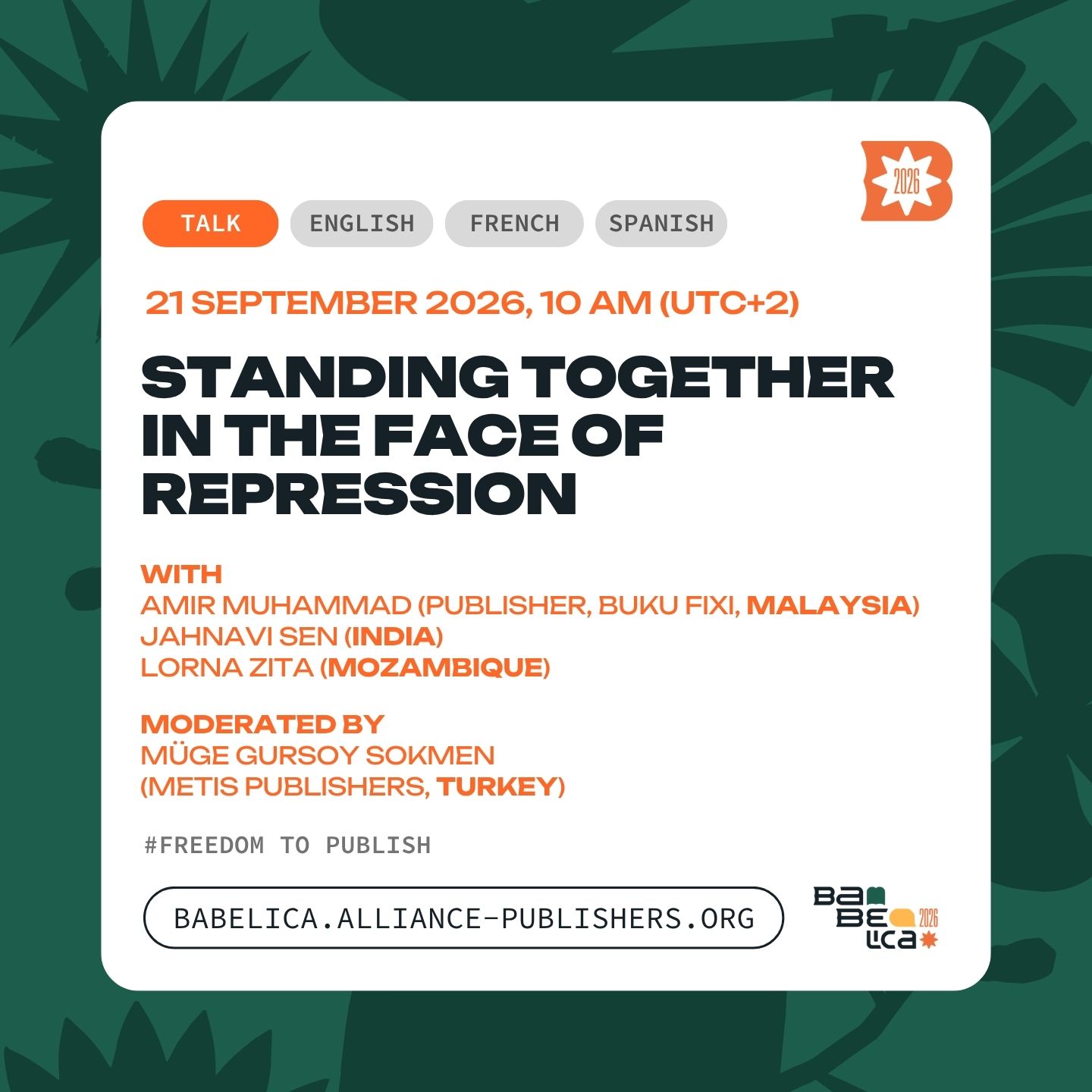
Standing together in the face of repression, 2026

Speakers :
Amir Muhammad, Malaysia (Buku Fixi)
Lorna Zita, Mozambique
Jahnavi Sen, India
Moderated by Müge Gursoy Sokmen, Turkey (Metis Publishers)

Amir Muhammad : “3 209 books are currently banned. It sounds like a lot but it means that there are millions that are not banned ! [...] We are acknowledging that censorship exists but we also are acknowledging that we have the right to talk about it.”

Lorna Zita : “We need to create a world where everyone can speak without fear. When we speak about repression, it is not only about stopping people to speak [...] when people be silenced, we lose important voice in the society.”

Jahnavi Sen : “An entire ecosystem knowing that everyone else also exists and continues to do that, it creates not just solidarity but also a sense of responsibility towards the other that you know. We have to hold this up for each other.”

Müge Gursoy Sokmen : “I’m coming from this country where we had a coup-d’état, a military takeover in Turkey in 1980 and that is why my publishing house was founded. We were students at that time but we wanted to continue talking about things that were important for us.”

This panel discussion took place during the 2026 edition of the Babelica Book Fair.

Partager l'article

Resisting authoritarianism, 2025

At a time when the far right is gaining ground in many countries, when a wind of authoritarianism, conservatism and extremism is spreading, when ultra-capitalist (or ultra-liberal) models are at work, many fundamental freedoms are being called into question. The book industry (and independent publishing in particular) is no exception. What are the consequences of these political, societal and economic shifts for the freedom to write, publish and read ? How are authors, publishers, booksellers and librarians around the world affected by this crumbling of democracy and freedom ? What are the mechanisms for circumventing these attacks on freedoms, the alternatives that have been put in place and the hopes held out by book professionals ?

Speakers :

  • Romana Cacchioli (Director of PEN International)
  • Gvantsa Jobava (President of the International Publishers Association)
  • Maia Simonishvili (Parliamentary National Library of Georgia, member of the IFLA European Regional Committee and the FAIFE Advisory Committee)

Moderated by Kenza Sefrioui (En toutes lettres, Morocco)

Cette table ronde s’est déroulée pendant l’édition 2025 de Babelica.

Partager l'article

Freedom to publish and decolonial issues : crossroads between Asia and Latin America, 2025

When discussing decolonialism in a formal and academic manner, we observe or criticise paradigms that, from a European and Western perspective, fail to take into account the particular characteristics of different societies and cultures, which are also classified as inferior to Western and European standards, particularly colonialist ones. As cultural agents, even if we do not call ourselves that, we can ask ourselves whether our publishing practice is part of that system of coloniality that leads us to want to reproduce, whether imposed or not, what is done by hegemonic cultures, or whether we have consciously distanced ourselves from it.

This raises some questions we can ask ourselves : how much freedom do we have to publish what we want to publish ? Are we really publishing with complete freedom ? If freedom is a concept that comes from Europe, when we publish, do we consciously distance ourselves from the ideas that seem to have been imposed on our non-hegemonic societies ? The book, that object produced by our publishing practice but above all a reflection of our cultural practices, manifests itself in different ways according to the different contexts in which we are immersed. Can we make it a tool for decolonisation, or should it be the one that is “decolonised” ?

The discussion about freedom of publication and decolonial issues from different countries and, therefore, cultures, raises more questions than answers, but it is also an opportunity to reflect on how we position ourselves in the broad publishing ecosystem and, therefore, in bibliodiversity.

Speakers :
* Faye Cura (Gantala Press, Philippines)
* Daniel Galeas Sarzosa & Natalia Alarcón Pino (Kikuyo Editorial, Ecuador)
* Kah Gay (Ethos Books, Singapore)
* Saeed Husain (Folio Books, Pakistan)
* Tonatiuh Trejo (Laboratorio Editorial Esto es un libro, Mexico/Chile)

Moderated by Nayeli Sánchez (La Cartonera, Mexico)

Partager l'article

Éditer et animer un fonds en SHS  : regards croisés d’éditeur·rices et libraires francophones, 2025

Quels sont les profils des lecteur·rices de livres de sciences humaines et sociales aujourd’hui  ? Comment les éditeur·rices conçoivent-ils/elles leurs choix éditoriaux  ? Comment les libraires pensent-ils/elles leur assortiment en librairie  ? Quelles sont les stratégies des éditeur·rices et libraires pour visibiliser et animer ces fonds  ? Autant de questions auxquelles les intervenant·es de cette table ronde répondront à partir de leur expérience et de leur contexte de travail.

Une table ronde co-construite par l’Alliance internationale de l’édition indépendante (AIEI) et l’Association internationale des Libraires francophones (AILF).

Avec  :
* Sulaiman Adebowale (Amalion Publishing, Sénégal)
* Karim Chikh (éditions Apic, Algérie)
* Mathieu Fabre (librairie Kyralina, Roumanie)
* Prudientienne Houngnibo Gbaguidi (librairie Savoir d’Afrique, Bénin)
* Kenza Sefrioui (éditions En toutes lettres, Maroc)
* Habib Zoghbi (librairie La Maison du Livre, Tunisie)

Modération  : Olivia Snaije (journaliste)

Partager l'article

Déborder Bolloré, 2025

Dans le contexte de la campagne Désarmons Bolloré et en emboîtant le pas au boycott appelé par les «  libraires antifascistes  », des éditeur·rices indépendant·es, ont coédité collectivement le recueil Déborder Bolloré, une publication multiformat pour prendre part depuis le secteur de l’édition à la réflexion générale sur le démantèlement de l’empire Bolloré.

Avec  :
* Arnaud Frossard, contributeur « L’odeur de l’encre. L’imprimerie : mirage des techniques, réalité des concentrations », éditions de la Grange Batelière et libraire, France
* Zoé Monti, coéditrice du livre Déborder Bolloré, Les Prouesses, France
* Théo Pall, coéditeur du livre Déborder Bolloré, éditions Burn Août, France

Partager l'article

Être éditeur·rice et libraire en contexte de génocide, 2025

Parole des acteur·rices du livre en Palestine

Avec  :
* Atef Al Durra (Al Kalima Publishing House - Gaza, Palestine)
* Samir Mansour (Samir Mansour Bookshop & Printing - Gaza, Palestine)
* Fuad Akleek (Al Raqamia Publishing House - Jérusalem, Palestine)

Modération : Fatma al Zahraa Sehwail (Gaza, Palestine)

Partager l'article

Recommander cette page