English

The Alliance

A literary and multilingual sound card: Happy B-Day and happy 20th birthday to the Alliance!

On 21 September, we are celebrating bibliodiversity and also the 20th birthday of the Alliance!

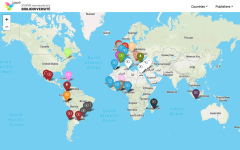
The publishers are offering you a literary world tour in more than 30 countries: 45 readings in 25 languages to listen to and watch here!

<media2433|insert|center>

<media2435|vignette|center>

A big thank you to all of you for this gift; thanks also to Naima Éditions for making this map.

Compartir el artículo

Children’s Books Hotlist

The Children’s Book HotList highlights children’s books from independent publishers in Africa, Latin America and Europe. It is launched during the 2021 Bologna Children’s Book Fair, on June 14.

<media2417|insert|center>

Comprising books from 16 countries, 36 publishing houses and 14 categories, this HotList represents the richness and diversity of independent publishing for youth and children’s literature.

You can find a book by searching its country, publisher or literary genre. If you are interested in a book, please do get in touch with its publisher.

We wish you a great discovery!

Compartir el artículo

The Arabic Language Network expresses its strong condemnation of the forced deportation campaign of Palestinians from the "Sheikh Jarrah neighborhood" in East Jerusalem, May 11, 2021

The Arabic Language Network of the International Alliance of Independent Publishers expresses its strong condemnation of the forced deportation campaign of Palestinians from the "Sheikh Jarrah neighborhood" in East Jerusalem, and the systematic violence and persecution led by the government of Benjamin Netanyahu against Jerusalemites in particular and the Palestinians in general in restoring the "apartheid" policies that the world seeks to overcome.

Read here the entire open letter from the Arabic Language Network of the Alliance.

<media2403|insert|center>

Compartir el artículo

2021 programme of the Alliance and 2020 highlights

Read here the 2021 programme of the Alliance and the 2020 highlights!

<media2394|insert|center>

Compartir el artículo

Des fourmis dans la bouche

Autor(es) : Khadi HANE
País de publicación : Argelia, Burkina Faso, Camerún, Costa de Marfil, Guinea, Malí, Marruecos, Togo
Idioma(s) : Francés
Precio : 50 dirhams marocains ; 750 dinars algériens ; 45 000 francs guinées ; 3 000 FCFA

Coeditores: Apic (Argelia), Eburnie (Costa de Marfil), Ganndal (Guinea Conakry), Graines de Pensées (Togo), Le Fennec (Marruecos), Proximité (Camerún), Sankofa & Gurli (Burkina Faso) y Tombouctou (Malí)
Fecha de publicación de la versión panafricana: 2021, 11,5 X 19 cm
Primera edición en Francia: Éditions Denoël, 2011
Maquetación para el colectivo de editoriales: Apic (Argelia)
Diseño de portada y correcciones: el colectivo de editoriales
Impresión conjunta en Argelia para Argelia, Guinea, Togo, Burkina Faso y Mali. Transporte de los ejemplares de Argelia a Malí por avión y luego envío a los distintos países por carretera.
Impresión local directamente en los países para Costa de Marfil, Marruecos y Camerún.

Esta coedición solidaria lleva la marca Le livre équitable (El libro justo).

Colección Terres solidaires

Creada en 2007, la colección “Terres solidaires” (Tierras solidarias) es una experiencia colectiva. Propone textos literarios de autoras y autores africanas/os, publicados por un colectivo de editoriales de África francófona. Gracias a la coedición solidaria, los textos se difunden, y son disponibles y accesibles para los lectores africanos; el ecosistema del libro local se preserva y se refuerza.
La colección “Terres solidaires” cuenta con el apoyo de la Organisation internationale de la Francophonie (OIF).

Compartir el artículo

International Conference of Independent Publishers, Pamplona-Iruñea, 23-26 November, 2021

To find out more about the participants, practical information and to follow the Conference online, go to Babelica, the Alliance’s virtual space!

Consult the program below and register now!

<media2389|insert|center>

To participate in the Conference, click here.

The Conference is organized by the International Alliance of Independent Publishers and the Association of Independent Publishers of Navarre, EDITARGI.

Physical meetings, virtual window, sound archives
The meetings can be followed in streaming (via the virtual space Babelica or the Alliance’s YouTube channel). They will also be recorded and may be the subject of audiovisual editing, depending on the agreement with the participants. The conclusions of the roundtables and workshops will be disseminated afterwards to all participants.

Bibliodiversity ambassadors!
Bibliodiversity ambassadors are public figures who have agreed to amplify the voices of independent publishers, to accompany the reflections and practices of publishers, to defend and support bibliodiversity. The personalities solicited will be revealed in the coming weeks!

Presence of international independent publishers at the Navarra Book Fair (25-28 November, 2021), organized by the Association EDITARGI
A collective stand dedicated to the invited international publishers will present the variety and diversity of independent production internationally. This collective stand will be a meeting place for readers but also a space for sales/ purchases/ trade of copyrights between invited and local professionals.

Calendar 2021 of the Alliance and the Pamplona Meetings
<media2407|insert|center>

Compartir el artículo

International Conference of Independent publishers 2019-2021

The “Conference”, a snapshot of independent publishing worldwide
Since the creation of the International Alliance of independent publishers (an international network of 750 independent publishers from 55 countries around the world) in 2002, the “International Assemblies/ Conferences” have been held every four to eight years and bring together some 100 independent publishers from around the world: in 2003 in Dakar (Senegal); in 2007 in Paris (France); in 2014 in Cape Town (South Africa) and in 2021 in Pamplona-Iruña (Province of Navarre/ Spain).

They represent a landmark moment for international independent publishers, bringing together actors from all continents – they collectively provide a portrait of global independent publishing (Latin America, Africa, Asia, Europe, the Arab world and Oceania). They are a unique space for debate, meetings, and reflection on independent publishing – with no other equivalent worldwide.

Celebrate and REthink in 2021...
Between 2017 and 2018, when the Alliance network was planning and launching the 2019-2021 conference, the goals of this event were obvious: celebrating bibliodiversity and the work of independent publishers, REthinking the solidarity practices that we build through perseverance and determination, but also the relationships with other book professionals, and the relationships with readers.

This is obvious in view of the progress made since the last meeting in 2012-2014, but also in view of the experience of the Alliance, which celebrates its 20th anniversary in 2021.

2020, a global health crisis, a year of transformation
While the consequences of the health crisis are still difficult to assess in detail from an economic, social, and political vantage point, REthinking remains obvious but also becomes a necessity.
Why are independent publishers important actors in this period of crisis? How do they accompany societal transformations and transitions at work? What are the tools and practices that they put in place to apprehend the realities of tomorrow, to understand them? In what ways do books and the ideas they convey help defend and preserve the diversity of creations, points of view, ideas?

“Tomorrow’s” independent publishing?
This Conference is thus a moment of documentation on the state of the world, an international mapping of the movements of transition and/or interruption.
Its objective is to question and inform discussions on the role of books – of ideas – as a social and emancipatory trajectory.
It is a space for reflection, sharing of experiences and practical know-hows concerning the issues of today and tomorrow: ecology, social economy, inclusive publishing, cultural platforming...
Finally, the Conference is a space of solidarity, trust, human relationships, and dialogues between cultures.

Process and phases of the Conference
The Conference of the Alliance is built of our own accord over a long period of time, against the often-frantic rhythm that has become the norm. It follows a common thread that has been running for 20 years within the Alliance: the issues defended by the Alliance since its creation are always prominent (solidarity, equity of relations, rebalancing of flows, circulation of ideas, local creations and productions, fair speech, ecological concerns...). These are the foundations on which the independent publishing movement is based and are addressed considering contemporary issues and debates.

They are built collectively, based on the work carried out since the 2021-2014 conference and the 80 ensuing recommendations, from feedback from professionals in the field of books, from monitoring independent publishing throughout the world, from regular dialogue with other cultural actors, but also from observation of practices, trends, and alternatives that emerge here and there.

The Conference is built on two levels (public and “internal”), which feed each other and are complementary.
• A public level with an aim to meet, discuss, learn – which is embodied by meetings open to all (book professionals, readers, cultural actors, academics, civil society movements, etc.). It is about taking advantage of the space that the Alliance is to REthink practices, question the relationship of independent publishers to the current world, explore themes, allow each other utopias, look together to the future.
• An internal level (focused on the Alliance network) to formulate recommendations and tools, to elaborate objectives for the upcoming period, to define and refine the governance of the network.

The conference is structured around working groups and thematic workshops set up since the 2012-2014 Conference of the Alliance (1/on public book policies; 2/on the freedom of publishing; 3/ on digital publishing; 4/on publishing in local and national languages; 5/on solidarity-based editorial partnerships; 6/on the impacts of book donation practices).

Concretely, for the Alliance network, the aim is to achieve the following results for the period 2022-2025:
• Recommendations (based on the 80 recommendations from the previous Conference but also in the context of the current crisis)
• Objectives and action plan for the period 2022-2025
• Adjustments and validation/ endorsement of the governance of the association

Compartir el artículo

An international selection of music, films and books: in 2021, let’s celebrate bibliodiversity together!

In 2021, we would like to share with you the highlights and cultural inspirations of the independent publishers who make up the strength of our network: international playlists and selections of music, books and films recommended by the members of the Alliance.

To be discovered every week on our social media (Facebook; Twitter; Youtube and Instagram) and throughout the year on the Alliance website...

Follow us to broaden your musical, literary and cinematographic horizons!

On Youtube, listen to the Alliance’s international playlist for 2021 and see all the recommendations of Alliance members below.

<media2379|insert|center>

Compartir el artículo

Bibliodiversity Observatory

"’It’s a real battle’: African authors fight for publishing independence", The Guardian, 2020

“Francophone African books are still very often published by French imprints, which can make them hard to get at home. But there is a growing push for change...

When Cameroonian author Daniel Alain Nsegbe first saw his debut novel for sale in his home city of Douala, the price was so high “you would have to ask someone to stop eating for two days in order to buy the book”. It was around 16,000 CFA francs (£20); the average monthly salary in Douala is £150. The book, Ceux qui sortent dans la nuit (Those Who Go Out at Night) was published by Grasset, a French imprint. [...]”

Read here the article by Olivia Snaije, published in The Guardian, 14 May 2020.

Compartir el artículo

Mapping public book policies in Latin America and Sub-Saharan Africa and Madagascar

An unprecedented mapping of policies supporting reading and books in 22 countries, which can be consulted and downloaded online: publicbookpolicies.alliance-editeurs.org

Arising from the observation of the lack of data on public book policies in regions where the member publishers of the Alliance operate, particularly in Latin America and sub-Saharan Africa, the public book policy mapping project is the result of several years of collaboration between book and publishing professionals, academics and experts on public book policies. It relies first and foremost on the investment and involvement of the Alliance’s member publishers, who are its primary actors. It is one of the flagship projects of the Bibliodiversity Observatory.

The mapping proposes several items: one entry per country (country fact sheets listing existing mechanisms for public support for books at the national level); a regional entry (comparative data through cross-cutting analyses). It is interactive and evolving: the fact sheets presenting the institutions and national public book policies can be amended and modified as the systems evolve. This mapping is thus intended to be extended to new countries in both regions, or even to integrate a new region in the long term (the Arab world in particular). For now, the mapping exists only in Spanish and French for lack of financial means to carry out a translation into English. The Alliance hopes to find the necessary funds to translate the mapping into English soon.

The objectives of the mapping are to:
• make available data on the public book policies of the respective countries;
• offer an overview of public book policies, freely accessible, consultable and reusable by professionals and public authorities;
• promote dialogue and exchanges between public authorities and publishers;
• develop advocacy tools for independent publishers;
• contribute to the establishment and consolidation of public book policies in developing countries (among others, for a greater circulation of books and ideas, for the appropriation of digital tools by book professionals, for balanced exchanges between North and South);
• affirm the role of civil society (book professionals and particularly independent publishers) in the development and implementation of public book policies.

<media2330|insert|center>

The Alliance warmly thanks the partners of this project: the Fondation de France and the Swiss SDC.

See the complementary issue of the Bibliodiversity journal “Public book policies”.

Press release

If you have any questions, please do not hesitate to contact the Alliance team at: equipe@alliance-editeurs.org

Compartir el artículo

Publishing & the Book in Africa: A Literature Review for 2019, by Hans M. Zell, 2020

Publishing & the Book in Africa: A Literature Review for 2019
The fifth in a series of annual reviews of select new literature in English that has appeared on the topic of publishing and the book sector in sub-Saharan Africa. Extensively and critically annotated and/or with abstracts, the present list brings together new literature published during the course of 2019, a total of 156 records.

Read the pre-print version here.

The final print/online version to be published in The African Book Publishing Record, vol. 45, issue 2 (May 2020).

Reprinted with permission of the author.
Copyright © Hans Zell Publishing Consultants 2019

Compartir el artículo

Indigenous publishing in sub-Saharan Africa: A chronology and some landmarks by Hans M. Zell, 2019

This chronological timeline sets out some of the key dates, events, and landmarks in the history and development of indigenous publishing in Sub-Saharan Africa. It also includes details of the major conferences, meetings or seminars on African publishing, held in Africa or at venues elsewhere, since 1968. An earlier version of this chronology first appeared in The African Publishing Companion: A Resource Guide, and has now been updated through to the period up to 2019, and considerably expanded to also include publication of a number of benchmark studies, conference proceedings, journals, and reference resources on the African book world.

Read here the pre-print version on Academia.edu, 21 October 2019.

Final version, to be published in African Research & Documentation. Journal of SCOLMA (The UK Libraries and Archives Group on Africa), no. 136 (2019)

Reprinted with permission of the author.
Copyright © Hans Zell Publishing Consultants 2019

Compartir el artículo

Minority languages / Coordinated by Nathalie Carré and Raphaël Thierry

Coordinated by Nathalie Carré (Institut National des Langues et Civilisations Orientales, Inalco) and Raphaël Thierry (independent researcher)

Publication: 2020

Contact the Alliance team to get a free digital version of this issue.

<media1973|insert|center>

Bibliodiversité review is co-published by Double ponctuation and the International Alliance of Independent Publishers.

See all the other issues of the review here (“Public book policies”, “Self-publishing”, “Publishing and commitment”, “Translation and Globalization”...)

Presentation
More than half of the languages spoken in the world are in danger of disappearing; if nothing is done, UNESCO estimates that 90% of languages will have disappeared in the course of this century. Languages are an essential part of a people’s culture, yet they are much more than just a tool for communication; they offer a unique view of the world and of the people who live in it. What can the publishing sector do – and is already doing – to help preserve and sustain these minority languages? This book attempts to answer this question through academic articles and testimonies of book professionals who, together, propose a novel approach to the subject.

In the light of their publications, the book analyses the situation of several minority languages - Haitian Creole, Corsican, Innu, Yiddish, Kikuyu, Basque, Malagasy, Náhuatl, etc. and shows that solutions are possible when the actors in the book system are mobilised.

Summary:

  • Publishing in minority languages – On diversity of publishing languages in a
    globalized context / by Nathalie Carré (Inalco, France) and Raphaël Thierry
    (independent researcher, France)
  • Creole publishing in Haiti – Obstacles, initiatives and development prospects /
    by Sandie Blaise, Duke University (United States)
  • The spread of Yiddish poetry in German speaking world – The case of bilingual editions / by Caroline Puaud, Paris Sorbonne University
  • Write and publish in Madagascar – How to reach the world? / by Dominique Ranaivoson, University of Lorraine (France)
  • Make minority languages dialogue (online) – The example of intergenerational collaboration in East Africa / by Pierre Boizette, Paris-Nanterre University (France)
  • Normativity, diversity and dynamics of creation in the contemporary Basque literary field – Study of its operating trends through the literary trajectory of Eñaut Etxamendi / by Itziar Madina Elguezabal, Bordeaux-Montaigne Doctoral school (France)
  • Locate, catalog, make visible – The place of minority languages in collections of the University Library for Languages and Civilizations Studies (BULAC) / Interview with Marine Defosse, Soline Lau-Suchet and Nicolas Pitsos, librarians at BULAC (France)
  • “As long as the language circulates, we will have books to produce” / interview with Bernard Biancarelli (Albiana Publishing, Corsica/France)
  • “Publishing must grow the world” – Mémoire d’encrier and the languages of the world / interview with Rodney Saint-Éloi, Mémoire d’Encrier Publishing (Quebec / Canada)
  • “Saving a language is a task for all of us” / by María Yolanda Argüello Mendoza, Magenta editions (Mexico)
  • Public book and reading policies for indigenous languages in Chile. Intervention (updated in 2020) in the Parliament of Books and Speech / by Paulo Slachevsky, Lom Ediciones (Chile)
  • Save, transmit – An example of transcription-translation from oral literature
    of some Vietnam’s peoples / by Mireille Gansel, translator, writer
  • PEN’s commitment to Linguistic Rights – The importance of writing, publishing and reading in marginalized languages / interview with Peter McDonald (University of Oxford) and Carles Torner (PEN International), July 2018, Oxford and London

Compartir el artículo

“Terres solidaires” collection

The “Terres solidaires” collection was created in 2007, to strengthen the circulation of African literature in the Francophone space. Publishing houses that contribute to the collection are based in sub-Saharan Africa and in North Africa. Initially created to republish books written by African writers published in France and make them accessible to an African readership through the solidarity co-publishing process, it is now republishing books originally appearing on African publishers’ lists. Such is the case with Munyal, les larmes de la patience, by Djaïli Amadou Amal, the 13th title of the collection, originally published in 2017 by Proximité publishing, based in Yaoundé, Cameroun.

Publishers select texts and work in close collaboration throughout the editorial process. The principle of a selling price adapted to the buying power of the readership (on average 3 500 FCFA, or 5 Euros) remains one of its pillars.

Read more here...

Compartir el artículo

Digital Lab

The Digital Lab was created by the International Alliance of Independent Publishers to support independent publishers in their activities, reflections and digital practices. As a space of reflection, exchanges and discussions on digital bibliodiversity in both the Northern and Southern hemisphere, the Lab also offers digital tools adapted to the needs of independent publishers while respecting local ecosystems.

The Alliance Lab is built around four focus areas:

  • Tools and resources for professionals
  • Reflections and discussions on digital publishing, including innovative initiatives in the countries of the South (surveys and analyses);
  • In situ workshops (capacity building and peer exchanges on digital matters);
  • A personalised tutorial offered to member publishers of the Alliance.

The Lab is updated and facilitated by independent publishers, the team of the Alliance and also through partnerships with independent professional organisations and collectives from various continents.

Compartir el artículo

Publishing in Africa: Where Are We Now? An Update by Hans M. Zell, 2019

Read here the pre-print version uploaded on Academia.edu 21 May 2019

Final version, to be published in two parts, in Logos: Journal of the World Publishing Community (https://brill.com/view/journals/logo/logo-overview.xml)

Part I: Volume 30 (2019): Issue 3, Part II: Volume 30 (2019): Issue 4

Reprinted with permission of the author.
Copyright © Hans Zell Publishing Consultants 2019

Compartir el artículo

Les éditeurs d’Afrique francophone sur l’échiquier du "glocal" (1980-2019), by Raphaël Thierry, 2019

Abstract:

In terms of languages, markets and labels, African publishing represents a field of constant discourse. It also continually questions not just the way we look at books, but also our relationship with them and with the international publishing industry. The time has long passed when the leading discourse on publishing in Africa was devoted primarily to a “book famine” related to the African economic crisis of the 1980s. Over the past three decades, the African book market has done nothing but grow on the continent, diversifying its increasingly dense and transnational production through the circulation of books and of publishing information. Nonetheless, quite often African publishing is presented in terms of the difficulties faced by its stakeholders, rather than those stakeholders’ agency, their capacity to develop their markets. Indeed, history has shown that the African publishing industry is a mirror of the globalisation of publishing and of its economic flux. That being the case, the economic challenges that one can observe in the African industry is thus a reflection of the imbalances, alternatives – also margins – of a world of books that is increasingly concentrated. In this sense, African publishing invites a two-fold interrogation: in Africa it must advocate a cultural and economic legitimacy within evolving socio-political situations and an outward-looking educational market. Internationally, it must position itself in terms of non-African publishing of literature and non-fiction that makes up the majority of African intellectual production in the world. By examining the discourse around African books, African publishers’ discourse, and the evolution of African books in French since the 1980’s, this article aims to question the relationship between the book industry in Africa and the globalisation of books phenomenon in order to bring to light a network of exchanges, tensions, and influences that turns the African book market into a veritable “glocal” space.

Read the article here (in French).

Thierry, R. (2019). Les éditeurs d’Afrique francophone sur l’échiquier du « glocal »
(1980-2019). Mémoires du livre / Studies in Book Culture, 10 (2).
https://doi.org/10.7202/1060972ar

Compartir el artículo

Recomendar esta página