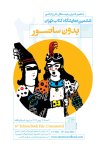
The sixth edition of the Tehran Book Fair, Uncensored takes place from 11 May to 12 June 2022, starting in London and then travelling through several European and American cities!
This book fair is timed parallel to the Iran Book Fair, hence the name: Tehran Book Fair, Uncensored. The aim of the exhibition is to provide an opportunity for authors and publishers who would be censored or banned in Iran to speak out freely and present their work.
In the aftermath of the Russian aggression against Ukraine and the invasion of its territory, the International Alliance of Independent Publishers expresses its support and solidarity with the Ukrainian people and cultural professionals and reiterates its commitment to the right of self-determination of each population.
We, independent publishers from over 55 countries around the world, members of an international solidarity network, condemn in the strongest terms the violence committed against the Ukrainian people and call together for a return to peace. We also reaffirm our support for all people on all continents, facing wars and conflicts, fighting for their freedom and emancipation.
We strongly oppose stigmatizing and dehumanizing discourses, and we recall here the essential role of culture, in particular of books, as a tool for dialogue, analysis, understanding and discovery of plurality and diversity.
Creada en 2007, la colección “Terres solidaires” (Tierras solidarias) es una experiencia colectiva. Propone textos literarios de autoras y autores africanas/os, publicados por un colectivo de editoriales de África francófona. Gracias a la coedición solidaria, los textos se difunden, y son disponibles y accesibles para los lectores africanos; el ecosistema del libro local se preserva y se refuerza.
La colección “Terres solidaires” cuenta con el apoyo de la Organisation internationale de la Francophonie (OIF).
The Independent Publishing Glossary is a collective project led by publishers from the Spanish-language network of the International Alliance of Independent Publishers.
It shows the meanings and definitions of words commonly used in publishing. It is an evolving project, which will be enriched over time in order to include new concepts and to take into account other proposal for definitions. The idea is not to freeze or petrify the concepts, but to open them up to enhance their multiple meanings.
Each term is signed by the person who worked on the definition. The glossary was edited by Germán Gacio Baquiola (Corredor Sur Editorial, Ecuador / Colectivo Editores independientes de Ecuador), Teresa Gottlieb, (Editorial Maitri, Chile), Paulo Slachevsky (Lom Ediciones, Chile) and Miguel Villafuerte, (Editorial Blanca, Ecuador).
Continue the analyses, reflections and advocacy via the thematic working groups set up during the 2014 Conference and set up new working groups on the themes and issues discussed during the 2021 Conference
Providing tools and documenting international independent publishing
2/ The Alliance, a space for collaboration and sharing
Share practices and know-how (on regional, national or even international levels, depending on the needs expressed) between publishers
Meet and strengthen the flow of exchanges
3/ The Alliance, a tool for promoting independent publishing and the circulation of books
Encourage the visibility and promotion of independent publishing
Promote the circulation of works and productions of independent publishing houses
4/ The Alliance, a laboratory of alternative editorial practices
Gathered in the city of Pamplona-Iruñea from 23 to 26 November 2021 at the fourth International Conference of Independent Publishers, organised in partnership with EDITARGI (Association of Independent Publishers of Navarre), we, the publishers of the International Alliance of Independent Publishers (IAIP), reaffirm our commitment to:
the cultural, social and political character of books and reading;
the democratisation of books in our societies;
reading as an emancipatory practice that strengthens the critical thinking of citizens and stakeholders within their society.
Read the full Declaration here:
This Declaration is in line with the discussions and work of the International Alliance of Independent Publishers, in particular the Declarations of 2003, 2007 and 2014 and the 80 recommendations in favour of bibliodiversity. It will be complemented by a Guide to Good Practice (collective work in progress, for publication in the first half of 2022).
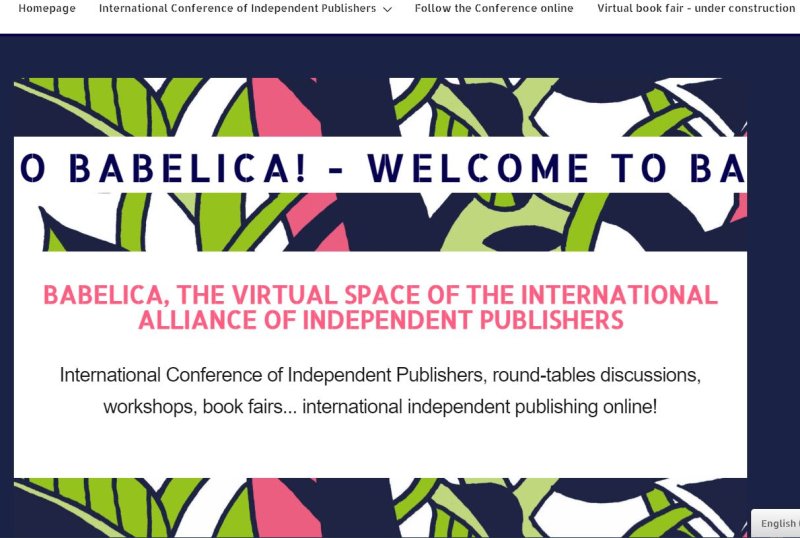
The International Conference of Independent Publishers held in Pamplona-Iruñea brought together more than 100 book professionals from 40 countries and was attended by more than 300 participants connected to the Babelica platform.
6 round-table discussions and 3 collective workshops in 4 languages of communication; B2B meetings; closing speeches by Vandana Shiva and Djaïli Amadou Amal...
The conclusions of the Conference are currently being drafted and will be available on the Alliance’s website in early 2022. They will present the highlights of the Conference, the proposals and recommendations of the independent publishers for REthinking, and the Alliance’s perspectives for the period 2022-2025.
The declaration of the Conference “For an independent, decolonial, ecological, feminist, free, social and solidarity-based publishing” is also being finalised (proofread by the different networks of the Alliance, in several languages). This declaration will be completed by a guide of good practices - the first drafts of this guide were elaborated during the Conference and are the object of a collective work within the Alliance, for publication during the first quarter of 2022.
The Alliance would like to thank once again all the partners of the Conference (see here) and especially the association EDITARGI, co-organiser of this unique meeting!
“Être éditeur au Maroc : la pensée au triple défi du marché, du droit et des libertés” / “To be a publisher in Marocco”
Kenza Sefrioui (En toutes lettres, Marocco)
In Morocco, it is very difficult to be a publisher, due to the conjunction between the lack of economical development of the sector and a long history of hostility of the authorities toward intellectuals, which destructured the fields of knowledge and culture. En toutes lettres’s experience, a young independent publishing house based in Casablanca and specialized in narrative journalism and humanities, proves the need to take the triple challenge of market, law and freedoms, and to invent new forms of solidarity between publishing, press, research and civil society, in order to rebuild a pole of production of critical thinking.
“Francophone African books are still very often published by French imprints, which can make them hard to get at home. But there is a growing push for change...
When Cameroonian author Daniel Alain Nsegbe first saw his debut novel for sale in his home city of Douala, the price was so high “you would have to ask someone to stop eating for two days in order to buy the book”. It was around 16,000 CFA francs (£20); the average monthly salary in Douala is £150. The book, Ceux qui sortent dans la nuit (Those Who Go Out at Night) was published by Grasset, a French imprint. [...]”
An unprecedented mapping of policies supporting reading and books in 22 countries, which can be consulted and downloaded online: publicbookpolicies.alliance-editeurs.org
The mapping proposes several items: one entry per country (country fact sheets listing existing mechanisms for public support for books at the national level); a regional entry (comparative data through cross-cutting analyses). It is interactive and evolving: the fact sheets presenting the institutions and national public book policies can be amended and modified as the systems evolve. This mapping is thus intended to be extended to new countries in both regions, or even to integrate a new region in the long term (the Arab world in particular). For now, the mapping exists only in Spanish and French for lack of financial means to carry out a translation into English. The Alliance hopes to find the necessary funds to translate the mapping into English soon.
The objectives of the mapping are to:
• make available data on the public book policies of the respective countries;
• offer an overview of public book policies, freely accessible, consultable and reusable by professionals and public authorities;
• promote dialogue and exchanges between public authorities and publishers;
• develop advocacy tools for independent publishers;
• contribute to the establishment and consolidation of public book policies in developing countries (among others, for a greater circulation of books and ideas, for the appropriation of digital tools by book professionals, for balanced exchanges between North and South);
• affirm the role of civil society (book professionals and particularly independent publishers) in the development and implementation of public book policies.
Publishing & the Book in Africa: A Literature Review for 2019
The fifth in a series of annual reviews of select new literature in English that has appeared on the topic of publishing and the book sector in sub-Saharan Africa. Extensively and critically annotated and/or with abstracts, the present list brings together new literature published during the course of 2019, a total of 156 records.
This chronological timeline sets out some of the key dates, events, and landmarks in the history and development of indigenous publishing in Sub-Saharan Africa. It also includes details of the major conferences, meetings or seminars on African publishing, held in Africa or at venues elsewhere, since 1968. An earlier version of this chronology first appeared in The African Publishing Companion: A Resource Guide, and has now been updated through to the period up to 2019, and considerably expanded to also include publication of a number of benchmark studies, conference proceedings, journals, and reference resources on the African book world.
Presentation
More than half of the languages spoken in the world are in danger of disappearing; if nothing is done, UNESCO estimates that 90% of languages will have disappeared in the course of this century. Languages are an essential part of a people’s culture, yet they are much more than just a tool for communication; they offer a unique view of the world and of the people who live in it. What can the publishing sector do – and is already doing – to help preserve and sustain these minority languages? This book attempts to answer this question through academic articles and testimonies of book professionals who, together, propose a novel approach to the subject.
In the light of their publications, the book analyses the situation of several minority languages - Haitian Creole, Corsican, Innu, Yiddish, Kikuyu, Basque, Malagasy, Náhuatl, etc. and shows that solutions are possible when the actors in the book system are mobilised.
Summary:
Publishing in minority languages – On diversity of publishing languages in a
globalized context / by Nathalie Carré (Inalco, France) and Raphaël Thierry
(independent researcher, France)
Creole publishing in Haiti – Obstacles, initiatives and development prospects /
by Sandie Blaise, Duke University (United States)
The spread of Yiddish poetry in German speaking world – The case of bilingual editions / by Caroline Puaud, Paris Sorbonne University
Write and publish in Madagascar – How to reach the world? / by Dominique Ranaivoson, University of Lorraine (France)
Make minority languages dialogue (online) – The example of intergenerational collaboration in East Africa / by Pierre Boizette, Paris-Nanterre University (France)
Normativity, diversity and dynamics of creation in the contemporary Basque literary field – Study of its operating trends through the literary trajectory of Eñaut Etxamendi / by Itziar Madina Elguezabal, Bordeaux-Montaigne Doctoral school (France)
Locate, catalog, make visible – The place of minority languages in collections of the University Library for Languages and Civilizations Studies (BULAC) / Interview with Marine Defosse, Soline Lau-Suchet and Nicolas Pitsos, librarians at BULAC (France)
“As long as the language circulates, we will have books to produce” / interview with Bernard Biancarelli (Albiana Publishing, Corsica/France)
“Publishing must grow the world” – Mémoire d’encrier and the languages of the world / interview with Rodney Saint-Éloi, Mémoire d’Encrier Publishing (Quebec / Canada)
“Saving a language is a task for all of us” / by María Yolanda Argüello Mendoza, Magenta editions (Mexico)
Public book and reading policies for indigenous languages in Chile. Intervention (updated in 2020) in the Parliament of Books and Speech / by Paulo Slachevsky, Lom Ediciones (Chile)
Save, transmit – An example of transcription-translation from oral literature
of some Vietnam’s peoples / by Mireille Gansel, translator, writer
PEN’s commitment to Linguistic Rights – The importance of writing, publishing and reading in marginalized languages / interview with Peter McDonald (University of Oxford) and Carles Torner (PEN International), July 2018, Oxford and London
The “Terres solidaires” collection was created in 2007, to strengthen the circulation of African literature in the Francophone space. Publishing houses that contribute to the collection are based in sub-Saharan Africa and in North Africa. Initially created to republish books written by African writers published in France and make them accessible to an African readership through the solidarity co-publishing process, it is now republishing books originally appearing on African publishers’ lists. Such is the case with Munyal, les larmes de la patience, by Djaïli Amadou Amal, the 13th title of the collection, originally published in 2017 by Proximité publishing, based in Yaoundé, Cameroun.
Publishers select texts and work in close collaboration throughout the editorial process. The principle of a selling price adapted to the buying power of the readership (on average 3 500 FCFA, or 5 Euros) remains one of its pillars.
The Digital Lab was created by the International Alliance of Independent Publishers to support independent publishers in their activities, reflections and digital practices. As a space of reflection, exchanges and discussions on digital bibliodiversity in both the Northern and Southern hemisphere, the Lab also offers digital tools adapted to the needs of independent publishers while respecting local ecosystems.
The Alliance Lab is built around four focus areas:
Reflections and discussions on digital publishing, including innovative initiatives in the countries of the South (surveys and analyses);
In situ workshops (capacity building and peer exchanges on digital matters);
A personalised tutorial offered to member publishers of the Alliance.
The Lab is updated and facilitated by independent publishers, the team of the Alliance and also through partnerships with independent professional organisations and collectives from various continents.